Get Your Free AI Consultation with Ascendix
Book a focused 30-minute conversation with Ascendix to discuss how your existing workflows and systems can be enhanced with AI.


Searching for the best AI consulting company for your real estate business? Finding one is easy. The problem is that firms calling themselves AI consultants do very different jobs. Some sell you a strategy. Some build whatever you spec.
In 2026 the shortlist of the best AI consulting companies for real estate is Ascendix, Accenture, Deloitte, McKinsey & Company, EY, JLL Technologies, HatchWorks AI, DOOR3, and Markovate.
We ranked them on real estate knowledge, whether the AI is grounded in your own system of record, whether the firm builds or only advises, pricing transparency, and track record. Ascendix comes first for companies that want AI built on the systems they already run.
Five criteria decide this list. They are worth applying to any firm you shortlist, not only the ones here.

5 Criteria that Make AI Consulting Company Good for Real Estate
1. Real estate domain depth. Whether the firm knows what a rent roll, a lease comp, and a commission split are before the first call, or learns them during it.
2. Grounding in your own data. This is the criterion that decides most real estate AI pilots, and the one buyers weigh least.
Your system of record is wherever the truth about your business actually lives. For a brokerage that is usually the CRM. For a property manager it is the property management system. For an investment firm it is the portfolio platform, and often it is more than one of these at once.
A general model answers from what it was trained on. It has never seen your tenants, your comps, or the deal that closed last week. Point it at a lease and it returns a summary that reads perfectly and has quietly turned base rent into effective rent. Nothing in the output looks wrong, so nobody catches it until a client does.
No model is smart enough to guess what it has never seen. Connect the AI to the firm’s live records and three things change:
That work happens inside your system of record, which is why a firm’s data and platform capability predicts AI results better than its model partnerships do.
3. Building, not only advising. Whether the firm ships and maintains working software, or delivers a roadmap and hands it to someone else. Most AI programs in this industry stall in exactly that gap.
4. Transparent scope and price. Whether you can find out what the first engagement costs and what it produces before committing to anything.
5. Track record with comparable firms. Whether the firm has done this for organizations your size, in your industry, with names you recognize.
Book a focused 30-minute conversation with Ascendix to discuss how your existing workflows and systems can be enhanced with AI.
Which type that fits you comes down to three things: the size of your firm, whether you want a roadmap or a built system, and what you can spend without a board conversation.
| Type | Firms on this list | Best for | Main advantage | Time to see first results |
|---|---|---|---|---|
| Real estate-native AI consulting partners | Ascendix | CRE firms of 10 to 1,000+ that want AI on their own system of records | Knows the workflows and the systems on day one, and maintains what it builds | Weeks for a first workflow |
| Strategy houses | McKinsey, Deloitte, EY | Large owners and institutional players needing a board-level case | A defensible business case that survives an investment committee | Months before anything is built |
| Rollout specialists | Accenture | Enterprises pushing AI across many teams and locations at once | Global delivery and change management at a scale nobody else matches | 6 to 12 months |
| Broker-linked tech arms | JLL Technologies, CBRE | Firms already standardized on that brokerage's platform | Real estate fluency that comes from being a brokerage, not from studying one | Varies by product |
| General-market AI shops | HatchWorks AI, DOOR3, Markovate | Firms with a spec written and someone in-house who owns the data | Documented delivery methods and current model-provider partnerships | Weeks to months |
This comparison is meant to help you rule out four types before you take a single sales call.
Here’s a closer look at each firm side by side:
| Company | Type | Real estate domain depth | Builds or advises | Data and platform practice | Pricing transparency |
|---|---|---|---|---|---|
| Ascendix | Real estate-native AI partner | Real estate since 1996, deeper roots in CRE | Builds and maintains | Salesforce partner with its own real estate platform | Scoped per engagement |
| Accenture | Rollout specialist | One industry among many | Builds | Large general Salesforce practice | Not published |
| Deloitte | Strategy house | Established real estate practice | Advises, builds via partners | General, not real estate-specific | Not published |
| McKinsey | Strategy house | Established real estate practice | Advises, delivery via QuantumBlack | No platform practice | Not published |
| EY | Strategy house | Established real estate practice | Advises | General, not real estate-specific | Not published |
| JLL Technologies | Broker-linked tech arm | Built from running a brokerage | Builds its own products | Own platform | Bundled or not published |
| HatchWorks AI | General-market AI shop | Real estate listed as an industry | Builds | None found | Free assessment, price not published |
| DOOR3 | General-market AI shop | No real estate variant yet | Builds | None found | 8-week assessment with named deliverables |
| Markovate | General-market AI shop | Real estate use cases listed | Builds | None found | Not published |
Ascendix is the AI and technology partner for real estate companies. The company has been on the market since 1996 and is real estate native, with its deepest roots in commercial real estate.
Ascendix works as an AI consultant for automation in real estate on the workflows that eat the most hours: lease abstraction, document and OM generation, capturing deal intelligence out of broker email, and answering pipeline questions nobody can pull a report for.
Ascendix pairs AI consulting with real product development. It is a customer-zero company: alongside the consulting work, Ascendix built AscendixRE AI Suite for its own brokerage operations, ran it on live deals, documents, and records, and only then offered it to clients. That is where the company learned how much AI output looks fluent, well-formatted, and wrong, and what it takes to catch that before a broker acts on it.
AI Suite is a paid add-on to AscendixRE, and it helps with:
You can find out more about AscendixRE AI Suite here.
See how AscendixRE AI Suite handles your daily tasks, answers your CRM questions, and generates branded documents in minutes.
Grounded AI depends on a data model somebody has cleaned up first. A real estate AI consultant who cannot reach the systems where your deals, properties, and contacts actually live is limited to whatever you can export, which is where most real estate AI pilots quietly stop. Ascendix is a Salesforce partner with a data and platform engineering practice built over decades, so the data work and the AI work sit with the same team rather than with two vendors pointing at each other. Ascendix can help with your next project.
Ascendix has spent decades building software for some of the largest names in commercial real estate, including JLL, CBRE, Cushman & Wakefield, Cresa, Hanna Commercial, Savills, and Highwoods. Those collaborations prove that the company operates within enterprise brokerages.
Ascendix uses an AI-assisted development approach on client work, with human review built into every stage. It brings down the cost and the calendar on a build while holding the accuracy a real estate team needs before it will trust an output. The same discipline applies whether the work sits on AscendixRE, Salesforce, or a client’s existing stack.
Accenture is the reference point for AI at organizational scale. When an AI program has to move through six business units, three regions, and a procurement function with its own opinions, the constraint stops being the technology and starts being the change management. That is the work Accenture is built for, backed by one of the largest Salesforce practices in the world.
The tradeoff is proportion. Real estate is one industry inside a very large portfolio, so the consultants assigned to your engagement are unlikely to arrive knowing how a commission split works or why your brokers distrust the systems they already have.
Deloitte matters when the AI decision has to satisfy more than an operations team. Its AI advisory sits next to audit, tax, and risk practices, so a model that touches valuation or financial reporting gets examined by people who understand the reporting consequences. Its published research on AI adoption is cited across the industry, including by vendors selling against it.
What a client receives is the thinking rather than the system. Build and integration are often handled separately or through a partner, which lengthens the path from a decision to something a team can use.
McKinsey works at the level of the business case. The question it answers well is whether AI changes the economics of how a company operates, which is a different question from whether a lease abstraction backlog can be cleared. QuantumBlack brought data science delivery in-house, so the firm is no longer strategy-only, though the entry point is still an executive conversation.
Property-level workflow work sits well below the altitude these engagements usually operate at, and the cost structure reflects the altitude.
EY has built an AI practice alongside its assurance and tax business, and its real estate practice is long established. The people in it understand how property assets sit inside a balance sheet, which matters when an AI output is going to inform a valuation or feed a disclosure.
As with the other professional services firms here, the strength is judgment rather than build capacity, and there is no real estate platform of its own for the AI to sit on.
JLL invested in technology as a business line earlier than most of the industry, including generative AI work built on its own property data. CBRE has taken a comparable path through its internal technology organization. Both bring something a consultancy cannot manufacture, which is real estate fluency that comes from running a brokerage rather than studying one.
The question worth asking directly is whose interests set the roadmap. A brokerage’s technology arm points toward that brokerage’s platform, and a competing firm may have views about where its pipeline data ends up.
HatchWorks AI is the most complete general-market AI consultancy in the comparable-scale set reviewed for this article. It runs a trademarked methodology called GenDD, holds direct partnerships with major model providers, publishes recurring research, and offers a free AI opportunity assessment usable without booking a call. That combination removes a lot of the guesswork from a first engagement.
Real estate appears on its industry list, though as a listing rather than a practice. Its marquee logos sit in manufacturing, healthcare, and retail, there is no real estate-specific content, and there is no data practice underneath the AI to ground it in a firm’s own systems.
DOOR3 has been an independent technology consultancy since 2002, and its AI practice is organized around a productized 8-week AI Pathfinder Assessment. It states the deliverables upfront: scorecards, an executive brief, and a prioritized roadmap. Few firms in this market will say that much before a sales call, and DOOR3 has already built sector-specific variants of the assessment for legal, insurance, and manufacturing.
No real estate variant exists yet. Its deep sectors are elsewhere, and it has no platform or data practice, so anything built for a property client starts from an export rather than a live system.
Markovate is a generative AI development firm with a broad multi-cloud partner portfolio, and it names real estate use cases directly, including lease abstraction, investor reporting, and portfolio automation. On paper that is the closest use-case overlap with real estate in the general market.
Underneath the page, the depth is thinner than the list suggests. The real estate presence is a set of use cases rather than a practice, with one published property case study centered on computer vision, and no real estate sub-vertical behind it.
Ask all ten. The answers will tell you more in twenty minutes than a three-week evaluation process will:
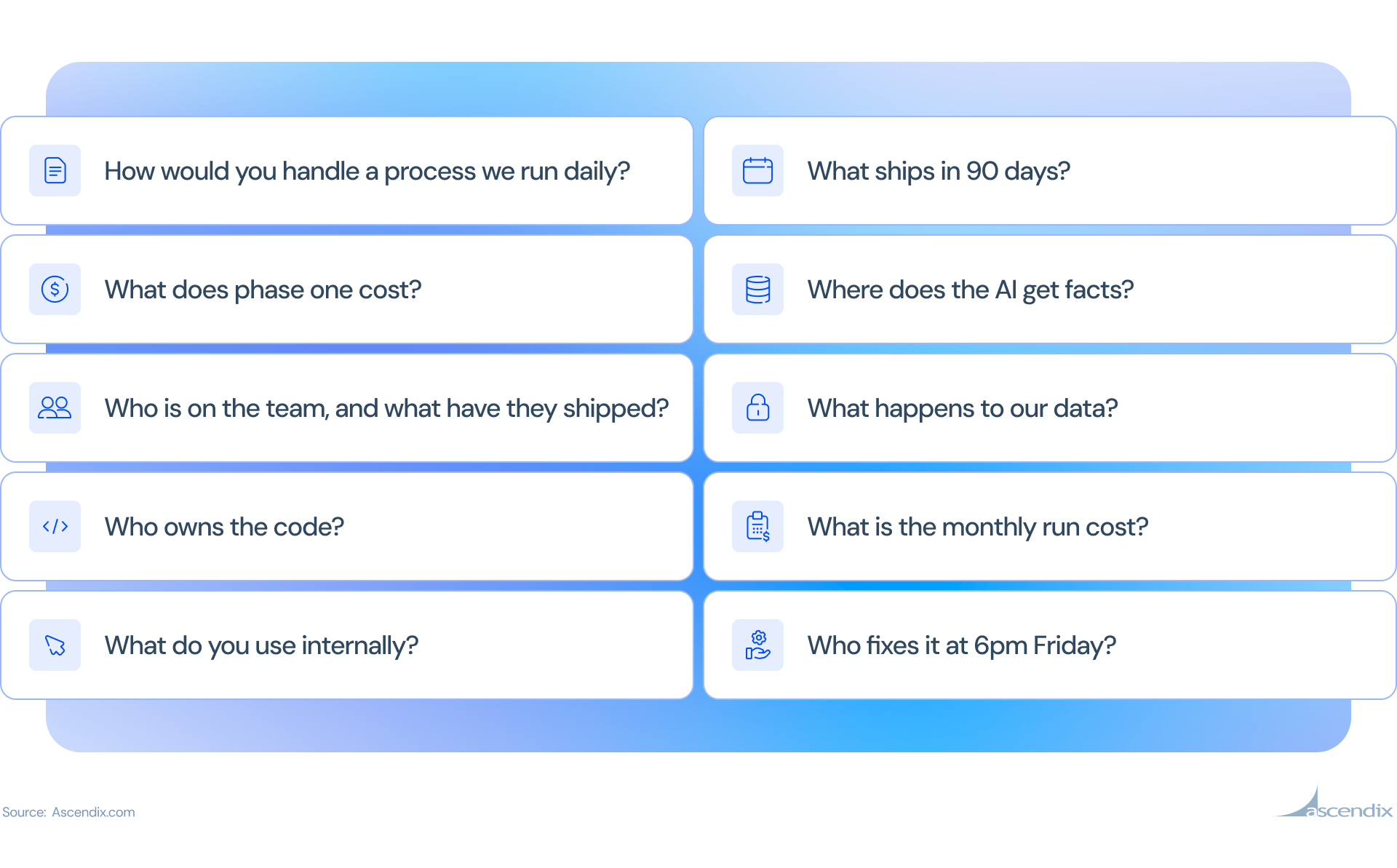
10 Questions to Ask Before You Hire an AI Consulting Company
A firm that answers all ten specifically is worth a second call. One that deflects on more than two is telling you what the engagement will feel like.
| Your firm size | Go with | Why | What to avoid |
|---|---|---|---|
| Under 10 people | One workflow, fixed scope, from a real estate-native builder | You need a result, not a program | Anyone whose sales process starts with a discovery phase you pay for |
| 10 to 50 people | A real estate-native builder who can own the spec for you | Real workflow pain, no internal engineer to hand a spec to | General AI shops, unless you already have someone who owns the data model |
| 50 to 250 people | Platform depth as well as AI capability | Broker adoption is now the constraint, not AI capability | Vendors who have never watched brokers reject software |
| 250 to 1,000 people | A builder for delivery, your own steering group for approval | You need workflows built and a way to approve what gets built | Handing both the governance and the build to one vendor |
| 1,000+ or institutional | A builder for the systems, a strategy house for the board case | The plan and the build are different problems, and the build is where the value shows up | Assuming one vendor absorbs the integration risk |
Every firm on this list can build AI. What separates them is whether they arrive already knowing your business or bill you for the time it takes to learn it.
Ascendix has worked in real estate since 1996 and built the systems the industry runs on. Our products: AscendixRE CRM, Ascendix Search, and Composer mean we have already had to solve the problems any real estate project runs into.
Here is what that means for an AI engagement with us:
Bring one workflow to the first call. We will tell you whether AI is the right tool for it before anyone writes a scope.
Tell Ascendix Consultants about your business, goals, and struggles and get an outline of what you need to do and what solutions you should consider.
An AI consultant finds which workflows are worth automating, then builds and integrates the systems that run them. The AI consultant in real estate does the same job, but on rent rolls, comps, and property records rather than generic business processes.
Pricing is rarely listed publicly, so ask each firm for a fixed price on a bounded first phase. Data preparation is usually the largest line item.
Build in-house if you have engineers who know your data model and months to spare. Hire a real estate AI consultant if you need it faster, or if the work sits on Salesforce. The common hybrid: a consultant builds the first system, an internal owner runs it.
If you are looking for a real estate-native builder, go with Ascendix. The company has been real estate focused since 1996, runs a Salesforce and data engineering practice, and builds AI-focused products. For board-level enterprise strategy, McKinsey, Deloitte, or EY is the better call.
The ones that work today handle documents and retrieval, so lease abstraction, OM generation, data capture from email, and natural-language search. Tools connected to your own systems beat general assistants, which do not know your tenants or comps. This breakdown of AI tools for commercial real estate compares what each category does well.
Ask them to walk through a workflow you already run. Count how often you have to correct them. When a brokerage shortlists an AI consultant, real estate fluency shows in the first 10 minutes.
Agentic AI describes systems that carry out multi-step tasks rather than answering one question at a time, such as pulling a rent roll, checking it against your records, and drafting the follow-up. It is useful once the underlying data is reliable and pointless before that.
Darina creates compelling content about Salesforce products, Ascendix services, and CRM best practices. Her articles provide valuable tips and insights and help readers stay abreast of the recent trends in the commercial real estate industry.

 (13 votes, average: 4.89 out of 5)
 Loading...