Embrace the Power of AI with Ascendix
Speed up your documentation management with AscendixDA – a powerful, customizable tool for optimizing paperwork processes.


AI in commercial real estate keeps shifting the industry. Approximately 75% of US real estate companies have already started using AI in their operations in some way (Deloitte). While McKinsey values AI’s potential in real estate at $110–180 billion, noting that early investors are already seeing returns of 15–20%.
This guide covers what AI in commercial real estate means in practice, the key benefits and drawbacks of CRE AI adoption, and the main tools and use cases shaping the industry today.
In our guide, we define AI in commercial real estate as the utilization of AI systems and tools to streamline various spheres and processes in the commercial real estate sphere and perform CRE tasks typically done by humans.
Commercial real estate AI typically executes some aspects (rarely – all manual operations) in commercial real estate, such as:
AI in commercial real estate can process large volumes of property data, market information, and operational metrics to generate insights and automate routine processes, which makes CRE processes more effective and less time & effort-consuming.
Because AI in CRE can instantly analyze large amounts of data, providing valuable insights, it can save commercial real estate specialists a great deal of time, money, resources, and manual effort. AI automation in real estate tasks makes the processes in commercial real estate faster, more efficient, and generally more optimized. If you’re not sure where to start, AI consulting services for commercial real estate can help you pinpoint which processes are actually worth automating first.
AI automation of real estate tasks brings significant productivity gains. The technology gap between traditional CRE businesses and commercial real estate AI companies is growing and will soon create an insurmountable competitive disadvantage with no In-between – firms either adopt AI now or risk losing deals to faster, more informed competitors who leverage these tools to underwrite more accurately, respond to RFPs instantly, and optimize portfolios smarter.
AI tools in commercial real estate automate time-consuming daily tasks that typically consume hours to weeks of manual work. AI can process thousands of property data points across fragmented systems, allowing you to focus on strategic insights rather than data gathering, refining, and manual entry. If you are searching for platforms, our comparison of the best AI CRMs for real estate breaks down exactly which tools handle these tasks and how.
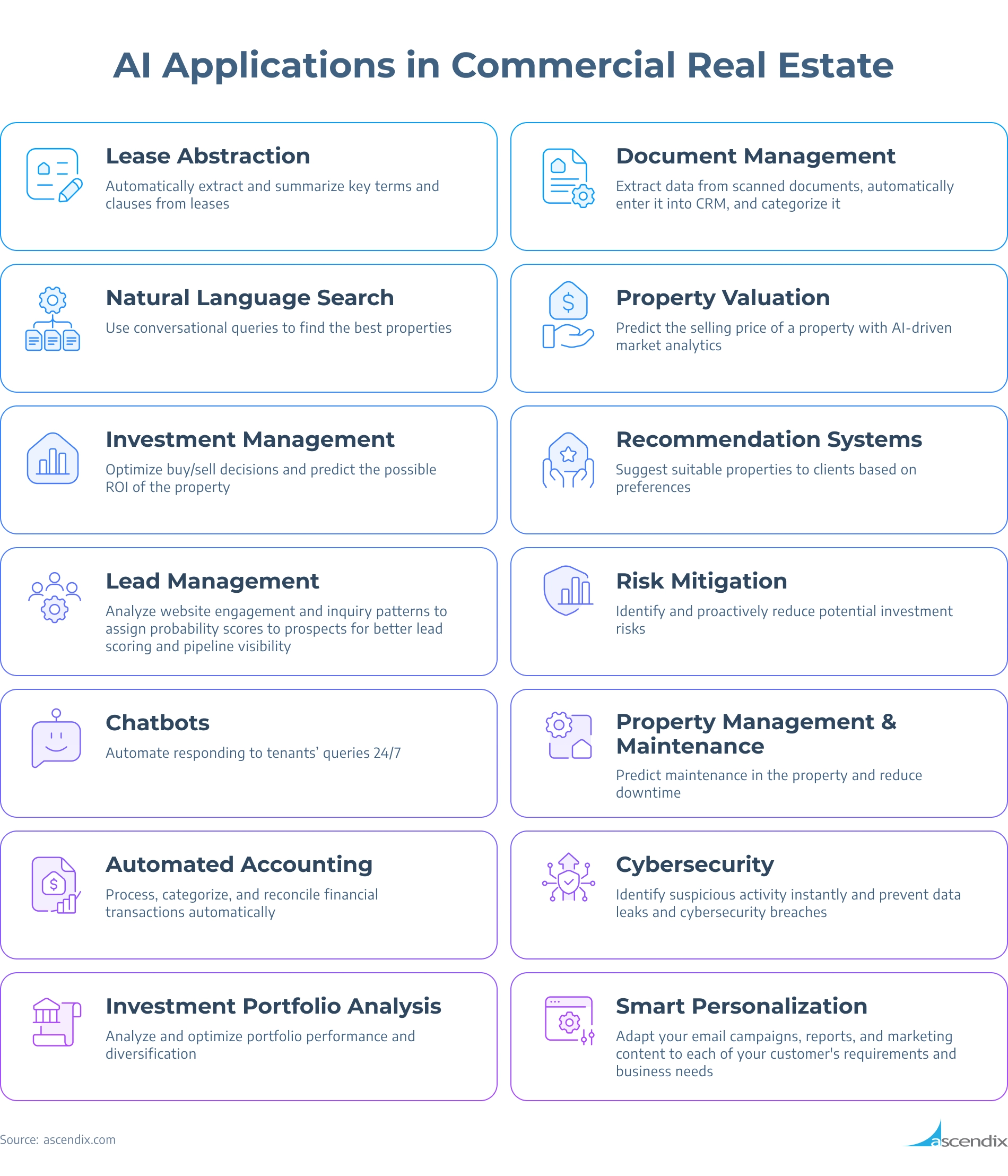
AI Applications in Commercial Real Estate | Ascendix.com
Some of the key applications of AI in CRE include automated lease documentation analysis, predictive maintenance systems that prevent equipment failures, and real-time market analysis. AI automation helps CRE professionals avoid common issues like missed maintenance problems, outdated investment reports, and lost client prospects.
Speed up your documentation management with AscendixDA – a powerful, customizable tool for optimizing paperwork processes.
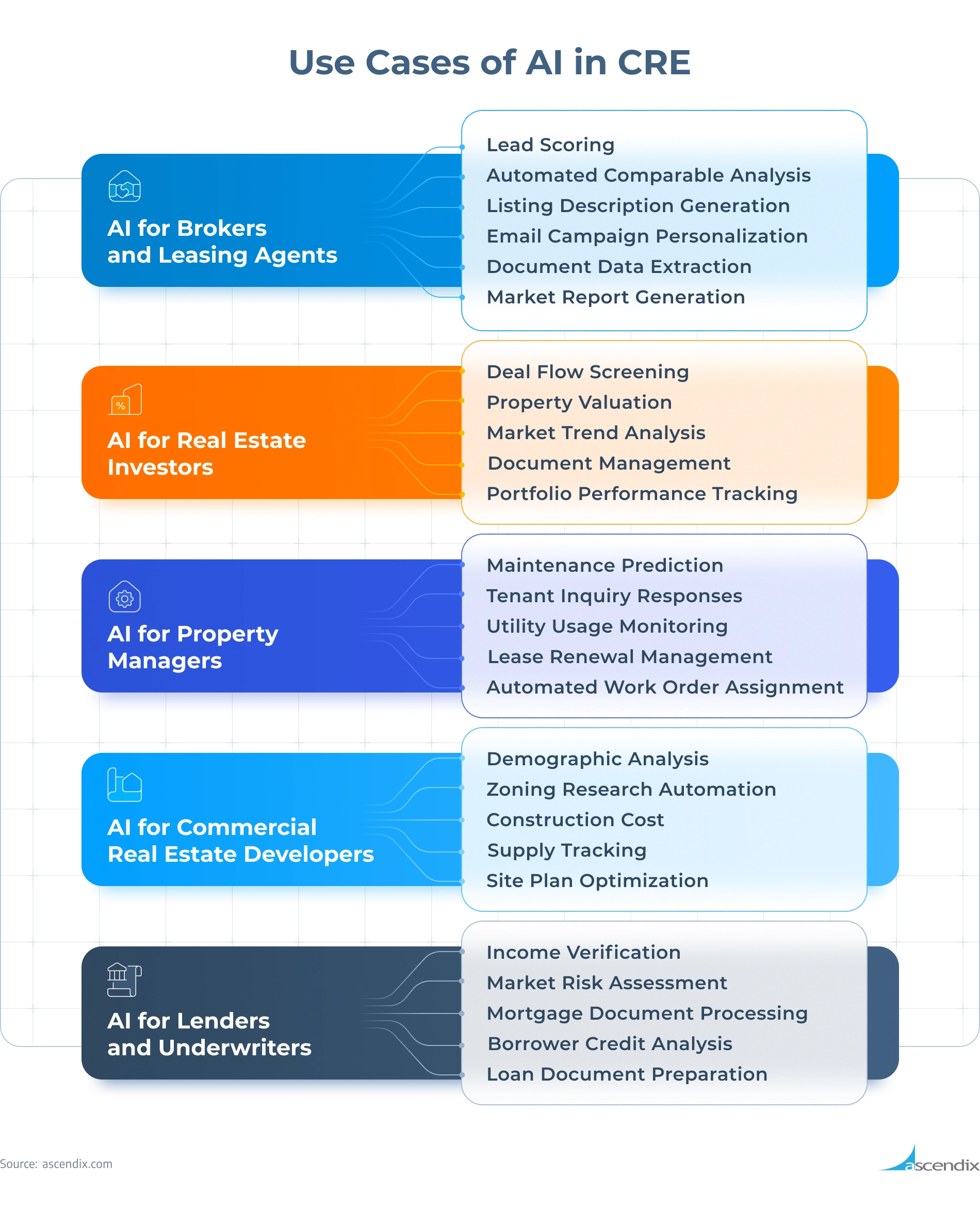
Use Cases of AI in Commercial Real Estate | Ascendix.com
The benefits and drawbacks of AI implementation are clear. Let’s now discuss how AI tools for commercial real estate transform workflows for each key role.
“ Real estate generates a lot of documents, lots of information is possessed in these documents. So we've become very aggressive in our investments in dealing with this inefficiency of abstracting data from these documents and having those be democratized in systems that are supporting decision-making on a daily basis. ”
Let’s discover how exactly AI in CRE helps professionals save time and optimize the use of resources.
Imagine AI is already implemented in your systems.
Here’s what your workday will look like:
Your morning today starts with a call with Dan Wilson about a Class A office building purchase in Dallas.
After you finish the call, instead of opening multiple CRM tabs and filling out forms, you simply talk to your AI agent:
“Just had a call with Dan Wilson from Wilson Associates. He’s looking at a Class A office building in Dallas. He owns 4610 Elm Street. His email is [email protected], phone 214-567-4645.”
And just after you say that, AI for CRE instantly creates contact, company, and property records with all relationships mapped in your CRM. No clicking, no typing, no reviewing the call transcript, and no hunting for the right screens.

How to Use AI for Taking Notes After the Client Meeting
Now, it’s time to search for properties suitable for your client.
You just ask your AI CRE assistant:
“Find me office properties in Dallas under $500k.”
Instantly, you get a curated list with complete details. The AI searches your database plus external sources simultaneously and provides the most relevant results.
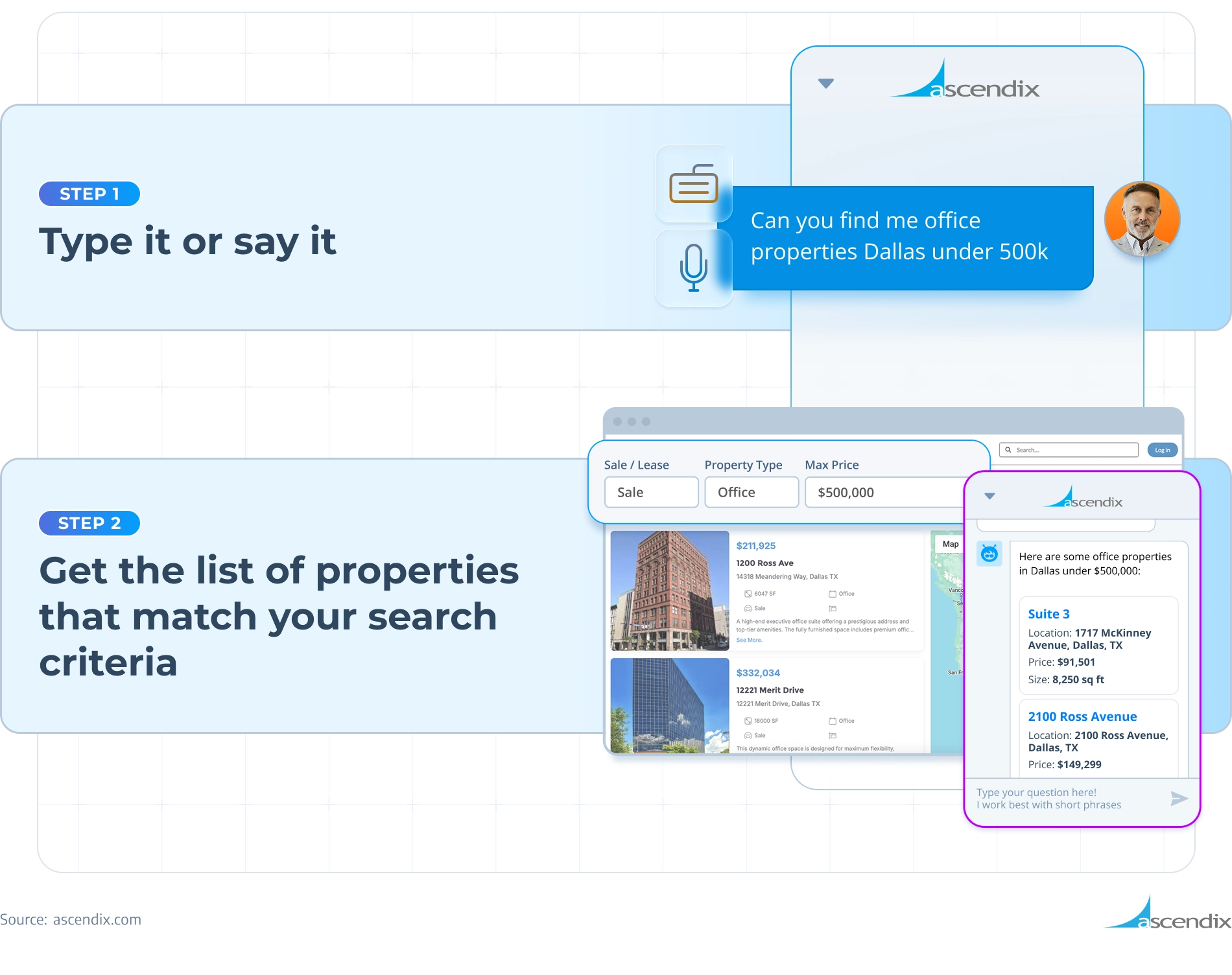
Finding a Property with CRE AI | Ascendix.com
Instead of crafting emails from scratch:
“Draft an email to Dan with the first 3 properties from that list. Let him know these are potential targets and I’m contacting owners to gauge interest.”
You simply give the AI assistant the task of creating the right email for the client with property details and personalized tone – and it will be ready in seconds.
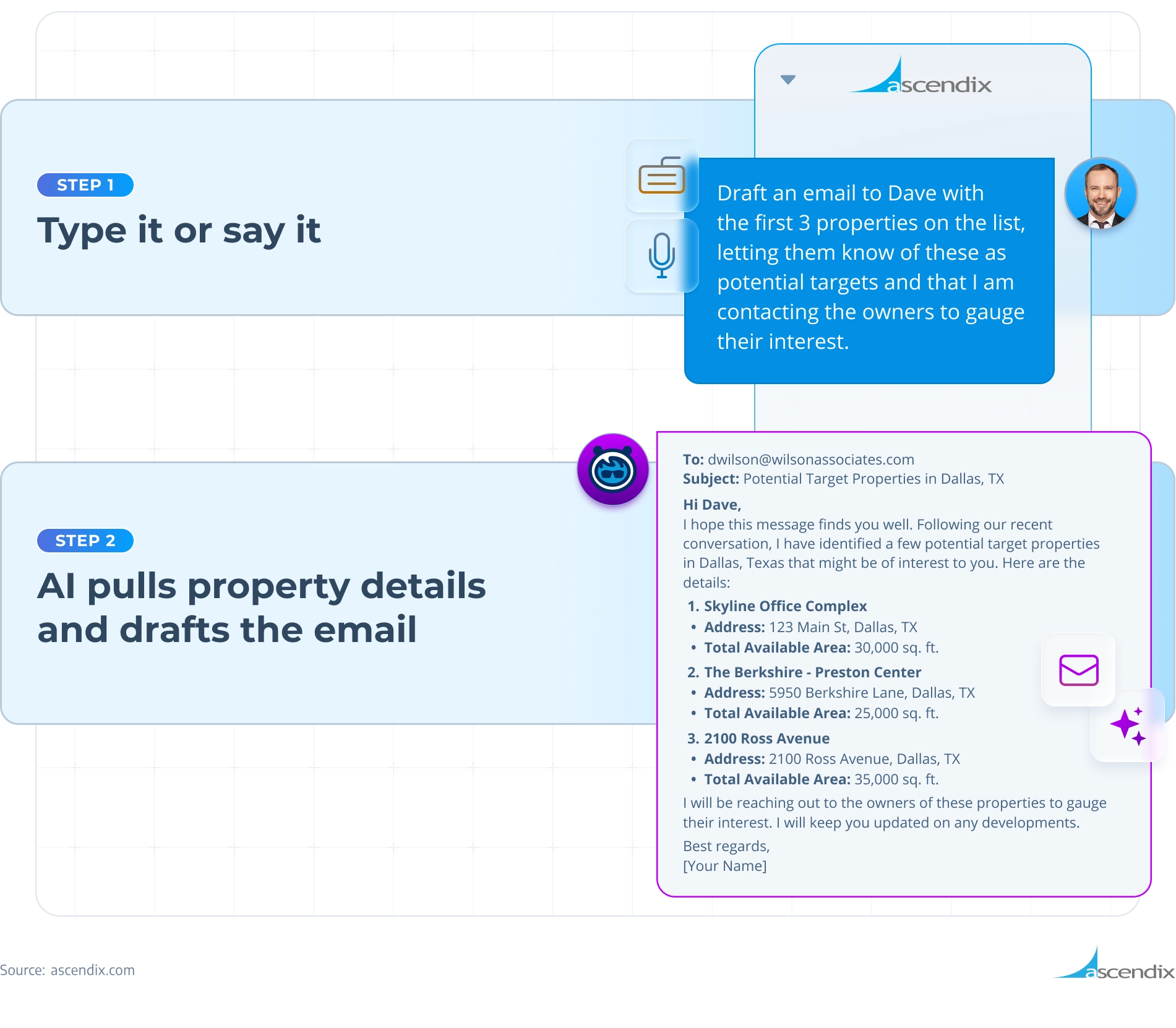
Communicate with Clients with AI | Ascendix.com
After meeting with tenant prospect Tim Abbott, you capture everything in one breath:
“Tim Abbott from Abbott Consulting needs 15,000-18,000 sq ft Class A office space in Dallas. Current lease expires July 2026. Email: [email protected], phone: 972-349-4538.”
Then: “Find properties matching Tim’s requirements.”
After AI returns three perfect matches, you continue: “Create a tenant rep deal for Tim, $1.8 million gross value, add those 3 properties as prospects.”
As a result, the deal record was created, with the client profile linked and properties attached to it – all 10 times faster than manual entry.

Create a Deal with AI in CRE | Ascendix.com
As you work, a long email thread arrives with a prospect discussing requirements for properties.
Instead of reading through everything and manually extracting details, you forward it to your AI, which then summarizes the conversation, identifies contacts and companies, extracts property preferences, and suggests follow-up tasks.
In the end, 20 minutes of work takes 10 seconds.
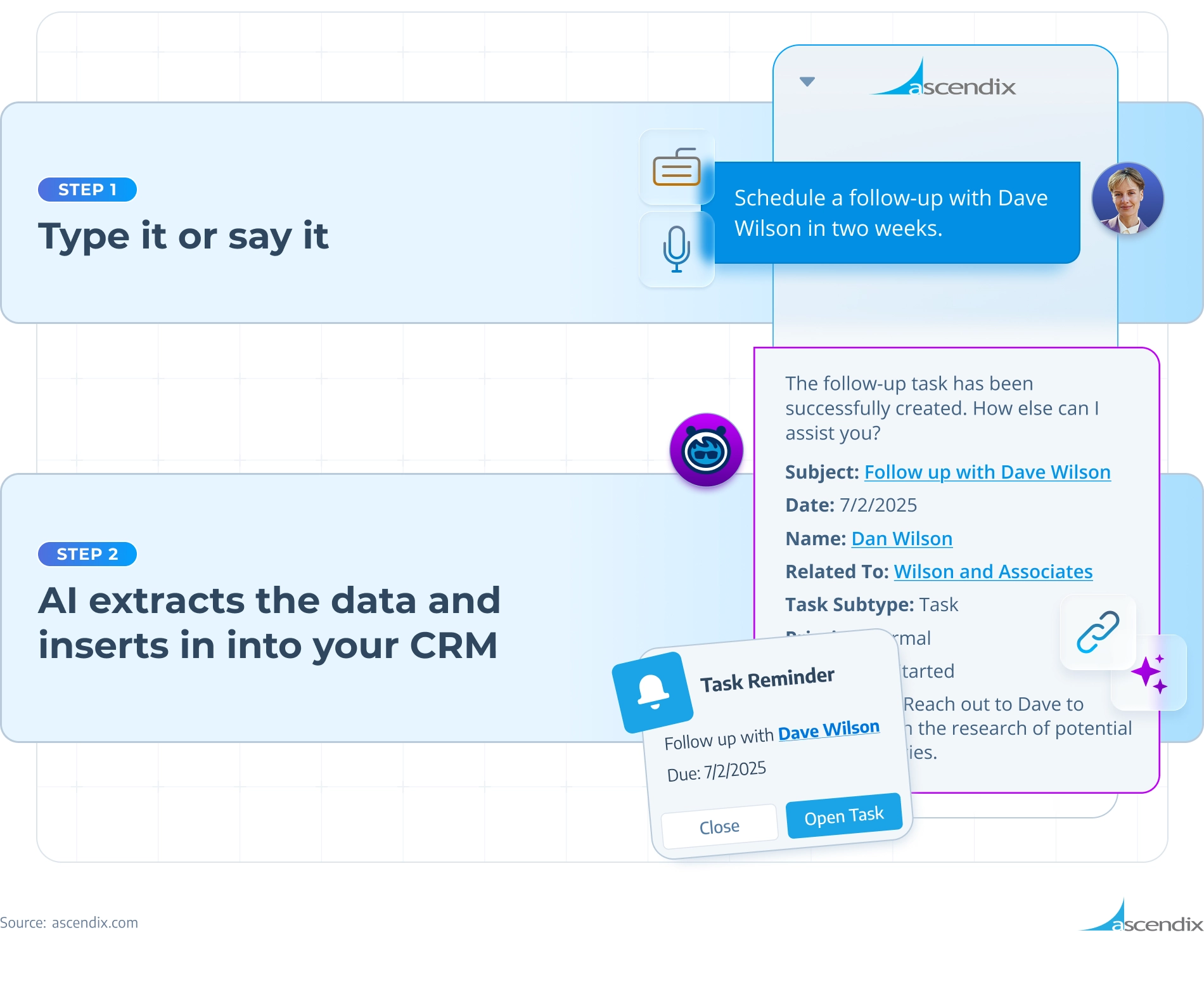
Drafting Emails with AI in CRE | Ascendix.com
At the end of the day, your client signed and sent you their lease agreement.
You upload the document to your AI tool, which extracts tenant details, lease terms, property info, rent amounts, and key dates, then exports everything to your CRM.

Discover how exactly AI agents and virtual assistants work in real commercial real estate scenarios in this 2-minute demo, shown by Wesley Snow, CEO and co-founder of Ascendix.
We will discuss your real estate business operations, evaluate the potential of AI implementation, and assess the possible benefits of using AI in the workflows.

Benefits of Using AI in CRE | Ascendix.com
AI automation of real estate tasks eliminates the bottlenecks that may limit your business’s growth.
Commercial real estate saves a load of time for you and your team by processing huge amounts of data in the blink of an eye.
This is especially useful in lengthy, highly manual processes like property valuations, which previously required weeks of analyst time, and with commercial real estate AI are now complete in hours with higher accuracy.
Some other examples of better operational efficiency brought by AI for commercial real estate are automated lease abstraction, when hundreds of documents are processed instantly and simultaneously.
These examples of AI in commercial real estate prove that now, with modern technology, firms can evaluate significantly more deals with the same team size, which therefore dramatically expands market coverage without proportional cost increases.
Apart from being longer, human analysis and manual processes inherently include more bias and a higher chance of oversight.
Luckily, commercial real estate AI eliminates both. AI systems analyze every data point objectively and base their decisions fully on the data available to them, which simply eliminates the possibility of overlooking anything.
The enhanced AI-proven accuracy directly impacts the bottom line: fewer bad deals, better pricing decisions, and more reliable portfolio performance projections.
AI-powered systems provide instant, personalized responses to client inquiries around the clock, ensuring no lead goes cold.
This provides commercial real estate businesses with an obvious advantage: while competitors take days to prepare custom property recommendations, suitable to clients’ requirements, AI tools for commercial real estate analyze listings and generate suggestions in seconds, not days.
The result? This responsiveness wins deals; companies that are using AI in commercial real estate already report higher client satisfaction and faster deal closure.
AI doesn’t just process data faster – it also reveals insights humans cannot see.
Having analyzed the market conditions and subtle signals simultaneously, as well as user behavior and sentiment, AI can identify emerging trends before they appear in traditional reports or real estate news.
The capabilities of predictive AI make proactive investment portfolio adjustments possible, identify optimal timing for acquisitions and dispositions, and find undervalued opportunities faster.
Companies using AI can significantly reduce their operational costs while simultaneously improving output quality.
AI for commercial real estate automates routine tasks, meaning the firms have a chance to eliminate overtime expenses and reduce staffing needs for repetitive work.
AI-driven commercial real estate operations require fewer resources to manage larger portfolios, review lease agreements and compliance, and suggest property options to clients.
These cost savings are instantly visible in the bottom line, enabling firms to offer more competitive pricing while maintaining or expanding profit margins.
“ That's an important lesson for any enterprise, commercial real estate, or otherwise, that's thinking, "How do I implement AI?" That exact line of thought is probably one of the best ways to approach it: "What can I do to impact my business the most now? Are there some pain points that I can address?" Don't try to go out and just think, "Oh, this will be cool." Don't do that. You have to understand yourself and your business.
You can't try to do everything at once. Pick one, two, or three pain points that you need to solve, and look to see if AI is ready to solve that pain. It may not be. That will be the recipe for a successful introduction of AI in your organization. ”
While the benefits of using AI in commercial real estate operations are obvious, it is also important to completely understand the challenges and possible concerns in using AI.
AI systems process vast amounts of sensitive financial, personal, and business information.
This makes commercial real estate companies using AI attractive targets for cybercriminals.
When introducing AI to the company, you must think firsthand about top-level cybersecurity infrastructure to protect client data, ensure GDPR and CCPA compliance, and maintain transaction confidentiality.
Solution: Ensure that your company uses not a publicly available ChatGPT (because it can directly lead to breaches and data leaks), but a proprietary AI tool that is fully secure and available only to your organization.
AI implementation demands significant upfront capital for professional software development services, software licensing, infrastructure upgrades, and system integration.
Beyond technology expenses, AI implementation for commercial real estate also must include data cleaning, migration, and ongoing maintenance processes – processes often overlooked, but which often make the budget exceed initial projections.
This may become a key issue for smaller firms, as they will have to spend significant sums without guaranteed immediate returns.
Solution: Before planning a full-scale implementation, get an AI consultation first. A trusted AI implementation partner experienced in real estate AI will give you a better understanding of what processes are included in your AI implementation and how much they may cost.
The biggest AI adoption barrier is not legacy systems, but a legacy mindset.
Experienced professionals who have successfully built careers on traditional methods often view AI as a threat, not a tool.
This resistance leads to slow adoption rates, underutilization of AI capabilities, and active sabotage of your implementation efforts.
Solution: The issue with the legacy mindset is that there is not a single solution that can resolve it. Some things that can help here are comprehensive change management, a lot of training, highlighting the value of A as well as your employees, and demonstrating that AI augments rather than replaces human expertise.
AI algorithms can perpetuate historical biases in property valuation, tenant selection, and investment decisions, which can then lead to reputational damage.
The lack of clear industry guidelines makes this challenge even more serious, as it leaves firms navigating regulatory landscapes on their own.
Solution: Commercial real estate AI systems must be constantly monitored to ensure compliance with evolving regulations and ethical standards.
Most CRE firms even now work in multiple disconnected systems, developed over decades.
AI tools for commercial real estate must integrate with these legacy platforms, which may require custom APIs, data standardization, and complete workflow redesign.
Poor integration creates data silos that simply eliminate the benefits of implementing AI in commercial real estate software, as the insights are one-sided, analytics – not complete, and firms may have to run several parallel systems instead of one.
Solution: Discuss integration of AI in commercial real estate systems from the very beginning with your AI implementation partner. This will save costs and ensure you are on the same page regarding this aspect.
Many CRE teams adopt AI expecting time savings, then find themselves busier than before. The tool drafts faster, but someone still has to verify every figure against the source document before it can travel. Deal detail that stayed in email, pipeline that nobody updated, contact records nobody logged: when AI draws from incomplete or stale data, the output looks finished but requires re-checking at every step.
This is what we call the wrong-hours problem. AI gives back the cheap hours — drafting, recapping, summarising — and quietly adds back the expensive ones in verification and correction. For the industry-wide numbers behind that gap, see our full breakdown of the state of AI adoption in real estate.
Solution: Before choosing an AI tool, understand which part of your workflow it is actually touching. AI aimed at keeping CRM records current, capturing deal detail from email and calls, and generating from data your team can trust returns the hours that matter. Todd Terry, co-founder of Ascendix, breaks down where AI actually saves time in commercial real estate workflows and how to evaluate any AI tool against that standard.
With 20+ years in real estate, expertise in technology, and our own AI frameworks, Ascendix is your best AI consulting partner.
Schedule a consultation to discover how AI can streamline your workflows.
Using AI for commercial real estate effectively needs more than an idea – it is a whole process of analysis, preparation, planning, budgeting, and development. Ascendix highly recommends finding a trusted AI partner who will walk you through the detailed steps of AI automation real estate tasks.
However, we will guide you through the main steps in the process for your general understanding of how things work.
It all starts with analysis and a thorough audit.
Commercial real estate AI delivers maximum value when applied to repetitive, data-heavy tasks.
Start by mapping your existing workflows and identifying processes that take up the most time and/or are the most prone to errors.
Priority areas where AI automation delivered the most value for our clients include:
At this step, you may also want to approximately assess the time and cost of current processes, which will then help you establish baseline metrics for ROI calculation of AI for CRE implementation.
Focus on workflows where 60% or more of the work involves data processing, analysis, or pattern recognition. These will give you the most return from AI integration in the future.
“ Tip from the Ascendix team:
Start with processes that already have clear, measurable outcomes or are assessed by KPI. If you can't measure the performance now, you can't prove AI impact in the future. From Ascendix’s clients’ experience, document processing and lease abstraction are the areas where you get the fastest wins with the biggest ROI metrics. ”
AI for commercial real estate requires clean, structured data to deliver accurate and truly valuable insights.
Without it, your AI findings will be biased and of no value.
Therefore, audit your data systems at the beginning to identify gaps, inconsistencies, and integration challenges.
What is included in the essential data preparation process:
Remember: organizations typically (always, actually) underestimate data preparation time and resources required for it, especially if the firm dates back decades.
Therefore, allocate 40-50% of your implementation timeline to this critical phase and don’t forget to prepare the budget for this stage.
“ Tip from the Ascendix team:
While data is crucial, we recommend not waiting for perfect data to start. In the early stages of your implementation, focus on core datasets like property information, tenant data, and financial records. You will be able to expand later. Perfect data that arrives too late loses to good data available now. ”
Introducing AI into commercial real estate processes can come in three main ways: developing a fully custom AI solution, integrating AI agents into your system, like integrating Agentforce AI agents into your Salesforce CRM, or getting a SaaS-based AI tool to optimize only some aspects of your work.
Ascendix has already talked about how to use custom AI solutions in real estate, as well as how to use Agentforce in real estate.
Now let’s answer the question
Choose AI solutions designed specifically for commercial real estate rather than generic business tools. CRE-specific platforms understand industry terminology, workflows, and compliance requirements.
Here’s the criteria you should evaluate while choosing an AI tool for CRE:
Regardless of which option you choose for your AI enhancement, always launch pilots with limited scope, like for only one property type or one location, or just basic functionality. This will help validate performance, check the results, and optimize even before enterprise-wide rollout.
AGet an understanding of what your business can achieve with the power of AI.
AI adoption fails when organizations neglect the human element.
As you plan and execute your technical AI in commercial real estate strategy, remember to develop comprehensive change management strategies addressing both technical training and cultural transformation.
You may need to think about:
Expect 3-6 months for teams to fully integrate AI into their daily workflows.
Patience during this transition period determines long-term success.
“ Tip from the Ascendix team:
Do not position AI as a replacement for humans – highlight its value as a tool for your team. Show how AI helps your employees handle 10x more deals, not how it automates their jobs. Successful implementation of AI still depends on humans using it effectively. ”
After a successful launch, expand AI implementation across the organization, but keep monitoring its performance.
As your commercial real estate AI implementation grows, you may need to establish separate teams to oversee its expansion, address challenges, and ensure ethical, safe, and compliant use of AI systems.
“ The biggest mistake we see is treating AI as a one-time implementation. It doesn’t work this way. You will need to budget around 20% of initial investment annually for optimization, retraining, and expansion. AI is a capability, not a project, so it requires constant development to bring the best results. ”
Ascendix brings 20+ years of real estate technology expertise to AI implementation in CRE. We’ve created solutions for industry leaders including JLL, and serve 300+ clients globally from five international offices.
AI implementation from scratch:
AI solutions and frameworks:
Salesforce Agentforce integration and consulting services:
Not sure which one is the most suitable for you?
Contact us and get a personal consultation with our representative to help you choose the best option.
Entrust your business to a true AI & real estate tech professional.
AI implementation costs in commercial real estate depend on factors like project aim, the number and kind of workflows to be automated, data quality, team size, and the grandeur of the idea. Given this, the costs may range from $10,000-$500,000+, which would include software licensing, data cleansing, management, migration and integration, tool development and deployment, staff training, hardware upgrades, and ongoing maintenance.
Primary CRE AI risks include data privacy breaches, algorithmic bias affecting property valuations, overreliance on automated decisions, integration challenges with legacy systems, cybersecurity vulnerabilities, compliance violations, and potential job displacement. Poor data quality can also lead to inaccurate property assessments and investment decisions.
Landlords can mitigate AI data privacy risks by implementing encryption protocols, anonymizing tenant data, establishing clear data governance policies, conducting regular security audits, ensuring GDPR/CCPA compliance, using secure cloud providers, limiting data access permissions, and obtaining explicit tenant consent for data collection.
Small CRE firms can start their AI journey with cloud-based AI tools that focus on specific use cases like lead scoring or market analysis, rather than trying to manage automation of all existing workflows. The most cost-effective option is to get a ready-made, highly customizable AI tool like AscendixDA for document abstraction. This is cheaper than custom development from scratch but also ensures the tool is highly tailored to the company’s specific needs.
Yana is a professional in Salesforce consultancy services. She shares valuable insights about Salesforce products and services, helping businesses choose the best solution for their operations.

 (13 votes, average: 4.89 out of 5)
 Loading...