The ‘wow’ phase of AI in commercial real estate is over. While in 2023, teams were testing prompts, in 2026, they expect AI to deliver results.
For some teams, the right starting point is ChatGPT or Claude for research and drafting. For others, it is NotebookLM for lease and rent roll analysis. Some need CRE-specific platforms for leasing, property intelligence, or lease abstraction. And firms that want AI to act inside trusted deal, property, and relationship data eventually need CRM-grounded AI.
In this guide, we compare the best AI tools for commercial real estate in 2026, where each type of tool fits, and how CRE firms can build an AI strategy that supports real adoption instead of adding more complexity.
AI Tools for Commercial Real Estate at a Glance
Below is a summary of the key AI tools and what each one does best for CRE professionals:
| Tool | Category | Best For CRE | Key Limitation |
| ChatGPT | General AI assistant | Research, drafting, summarization, brainstorming, document analysis | Does not know your live CRE data unless connected or provided as input |
| Claude | General AI assistant | Long-document review, structured analysis, writing, summarization | Strong with documents, but not a CRE system of record |
| Gemini | General AI assistant / Google Workspace AI | Research, writing, summarization, Google Workspace productivity | Best fit for teams already using Google Workspace |
| Microsoft Copilot | Workplace AI | Productivity across Outlook, Teams, Word, Excel, PowerPoint, and SharePoint | Generic productivity layer; value depends on Microsoft 365 data quality |
| NotebookLM | Source-grounded AI | Asking questions from uploaded documents and source materials | Limited to the documents and sources provided |
| Gamma | AI presentation tool | AI-generated decks, one-pagers, and visual documents | Not built around CRE deal logic or market data |
| Genspark | AI content workspace | Slides, docs, images, video, and broader content generation | Broad AI workspace, not a CRE workflow system |
| FormulaBot | Spreadsheet AI | Excel and Google Sheets formulas, cleanup, and quick analysis | Useful for spreadsheet work, not a CRE underwriting engine |
| Henry AI | CRE deal marketing AI | OMs, BOVs, loan packages, syndication decks, and leasing flyers | More CRE-specific, but still depends on accurate source data |
| LeaseLens | Lease abstraction AI | Extracting key data from commercial lease documents | Outputs still require review for business-critical use |
| EliseAI | Property management AI | Leasing communication, resident support, payments, and service requests | Stronger for multifamily and residential operations than brokerage |
| VTS | CRE leasing and asset platform | Leasing, asset intelligence, tenant demand, and market signals | Best for firms managing leasing and portfolio workflows at scale |
| Reonomy | Property ownership intelligence | Off-market sourcing, ownership research, property records | Data intelligence, not end-to-end workflow automation |
| CoStar | CRE data and intelligence platform | Market data, comps, availability, and property intelligence | Broader CRE data platform, not simply an AI tool |
| Cherre | Real asset data infrastructure | Data unification, portfolio intelligence, reporting, trusted AI workflows | Foundational platform, not a lightweight productivity tool |
| Agentforce | Salesforce agentic AI | CRM agents, task automation, pipeline support, Salesforce workflows | Requires clean Salesforce data, configuration, governance, and adoption planning |
| xRe AI Suite (AscendixRE) | CRE-native AI suite for CRM | Email-to-CRM data capture, plain-language CRM queries, branded document generation | Requires AscendixRE |
| Make | No-code automation | Connecting apps, AI tools, CRM, documents, and spreadsheets | Requires clear workflow design and governance |
| n8n | Technical workflow automation | APIs, AI steps, custom logic, and controlled automation | Better suited for technical teams or implementation partners |
| Lovable.dev | AI app builder | Prototyping internal tools, dashboards, portals, and workflow apps | Production use requires technical, security, and compliance review |
How to Read This Guide: Start With the Workflow, Not the Tool
There are more AI tools for commercial real estate than most teams can realistically evaluate. Some help brokers research, write, and analyze faster. Some help teams ask questions from leases, rent rolls, and internal documents. Others support presentations, spreadsheets, leasing workflows, property research, CRM updates, automation, or custom software development.
That is why the most important question is not, “What is the best AI tool for CRE?”
The better question is:
“Where is our team losing the most time, and which type of AI can remove that friction?”
As Topher Stephenson, CRE AI speaker and co-founder of CRE AI Studio, puts it:
“ There are so many AI tools now that it’s easy to get lost. The better starting point is to figure out what takes up most of your time, then apply AI there. ”
That is the best way to read this guide. Do not treat the tools below as a single shopping list. Treat them as categories of AI that solve different levels of work.
Before choosing an AI solution for commercial real estate, many businesses use CheckMySaaS to compare software features, pricing, and independent reviews, helping them make more informed purchasing decisions.
If none of the tools fit your processes, you can develop your own with Ascendix AI development services for real estate.
You can also consider AI consulting services to understand which tools will be suitable for your unique processes.
Some tools help individuals move faster. Some help teams work with documents. Some connect AI to spreadsheets, presentations, CRMs, leasing workflows, or property data. Others support more advanced automation and custom applications.
The right choice depends on three things:
- The workflow you want to improve;
- The quality and accessibility of your data;
- Whether the tool fits how your team already works.
Best CRE AI Tools in 2026
General AI Tools for CRE Research, Writing, and Analysis
General AI tools are often the easiest starting point for commercial real estate teams because they do not require a major implementation project. Brokers, analysts, marketers, operations teams, and executives can use tools like ChatGPT, Claude, and Gemini to move faster on everyday knowledge work: research, drafting, summarization, and analysis.
They do not automatically know your firm’s live CRM data, deal history, property database, relationship context, or internal processes. But when supplied with the right inputs, they can help CRE professionals reduce the time spent turning scattered information into usable outputs.
| Tool | Best For | Limitations |
| ChatGPT | Research, drafting, summarization, idea development, document analysis | Does not know your live CRE data unless connected or provided as input |
| Claude | Long-document analysis, summarization, writing, structured reasoning | Strong with documents, but still not a CRE system of record |
| Gemini | Research, writing, summarization, Google Workspace productivity | Best fit depends on how much the team already works in Google tools |
| Deep Research tools | Multi-source web research and structured reports | Useful for market research, but outputs still require verification |
1.ChatGPT and Claude
ChatGPT and Claude are everyday AI assistants for brokers, analysts, marketers, operations teams, and executives.
They can help with:
- Drafting broker outreach emails and follow-ups;
- Summarizing call notes and meeting transcripts;
- Creating first drafts of market commentary;
- Turning property details into listing descriptions;
- Comparing lease clauses when source documents are provided;
- Drafting due diligence checklists;
- Creating proposal language and executive summaries;
- Brainstorming tenant prospecting angles;
- Developing internal SOPs for recurring workflows;
- Summarizing long reports or research documents.
For example, a broker could use ChatGPT to turn rough notes from a landlord conversation into a polished follow-up email. An analyst could ask Claude to summarize a market report and extract the most relevant points for an investment memo. A marketing team could use either tool to draft listing descriptions, campaign copy, and social posts.
The limitation is context. These tools only know what the user provides in the conversation unless they are connected to other systems through approved integrations. They do not automatically understand your active pipeline, relationship history, property records, pursuit strategy, or internal approval process.
That makes them valuable for one-off productivity tasks. But for repeatable CRE workflows, the next step is usually not “better prompting.” It is connecting AI to the systems where the work actually happens.
2. Gemini
Gemini is useful for commercial real estate teams working inside the Google ecosystem. It can support research, writing, summarization, and productivity across Google Workspace.
For CRE teams using Gmail, Google Docs, Google Sheets, and Google Drive, Gemini can help with drafting, research, document summaries, and spreadsheet support.
Like ChatGPT and Claude, it is not a CRE-specific platform. Its value depends on how well it fits the tools your team already uses.
3. Deep Research
Deep research is available inside ChatGPT, Claude, Gemini, and other major LLM platforms. It goes beyond a single search query and synthesizes information from dozens of sources across the web into a structured report. For CRE professionals, this compresses hours of manual research into minutes.
Key applications in commercial real estate:
- Market research and submarket analysis;
- Deal sourcing and identifying off-market opportunities;
- Tenant prospecting: financial health, expansion activity, lease expirations;
- Finding distressed properties and motivated sellers;
- Competitive market mapping before a pitch.
General AI is often the easiest starting point. But when the question is not “help me draft or research” and instead becomes “what does this specific lease, rent roll, or report say?”, CRE teams need source-grounded AI.
4. Microsoft Copilot
Microsoft Copilot belongs in this everyday productivity layer because many CRE firms already work inside Microsoft 365. It can help with emails in Outlook, meeting summaries in Teams, documents in Word, spreadsheet analysis in Excel, presentations in PowerPoint, and content stored across SharePoint.
For CRE teams, Copilot can reduce administrative drag around:
- Meeting recaps;
- Follow-up drafts;
- Internal summaries;
- Proposal outlines;
- Spreadsheet support;
- Presentation creation;
- Searching across Microsoft 365 content.
The important limitation is that Copilot is not automatically a CRE workflow engine. It can summarize a meeting, but it will not necessarily know whether a CRM record should be updated, whether a deal stage changed, which property record is the source of truth, or what compliance rules apply to a client document.
This is where CRE firms need to distinguish between productivity AI and workflow AI. Productivity AI helps people work faster inside common tools. Workflow AI connects to business data, applies process logic, and helps work move through the organization with less manual effort.
| Tool | Best For | CRE-Specific Limitation |
| NotebookLM | Asking questions from uploaded documents, lease files, rent rolls, reports, and research | Limited to the sources uploaded or connected |
| Claude / ChatGPT with files | Summarizing and comparing provided documents | Useful, but not a structured lease abstraction or data system |
| AI document processing platforms | Extracting structured fields from documents | Requires configuration, review, and workflow integration |
5. NotebookLM
NotebookLM is useful when the question is not “Can you help me draft this?” but “What do these specific documents say?”
That distinction matters in commercial real estate because so much important information lives in leases, rent rolls, offering memorandums, appraisals, loan packages, market reports, and due diligence folders.
A CRE team could use NotebookLM to:
- Ask questions from uploaded lease documents;
- Summarize rent roll details;
- Pull key points from offering memorandums;
- Compare themes across market reports;
- Review due diligence materials;
- Create source-grounded summaries from internal research.
Its strength is that responses are grounded in user-provided sources. That can reduce the risk of open-ended AI hallucination and make the tool more useful for document-heavy work.
But NotebookLM is still limited by the documents provided. If the wrong version is uploaded, if a rent roll is outdated, or if key information sits outside the source set, the answer may be incomplete.
NotebookLM helps teams read and understand documents faster. It does not by itself turn document content into structured CRM data, automate follow-up workflows, or create a governed source of truth.
That distinction matters. Document Q&A is valuable. Document intelligence becomes much more powerful when extracted data can flow into the systems where teams manage deals, assets, relationships, and reporting.
6. Gamma and Genspark
Gamma and Genspark help teams create content and presentations faster.
Gamma is useful for AI-generated decks, one-pagers, visual documents, and presentation-style pages. CRE teams can use it to create first drafts of pitch decks, internal presentations, listing materials, market summaries, or proposal concepts.
Genspark is broader. It supports content creation across slides, documents, images, videos, and other formats. For CRE marketing and business development teams, it can help create early drafts of campaign assets, internal summaries, and presentation materials.
These tools are helpful because presentation work is time-consuming, and CRE teams often need to move quickly from information to client-ready materials.
The limitation is that design speed is not the same as deal intelligence. A good-looking deck still needs accurate property data, market context, financial assumptions, and a clear story. AI can accelerate the first draft, but the strategic judgment still comes from the team.
7. FormulaBot
FormulaBot is useful for teams that spend a lot of time in Excel or Google Sheets. It can generate formulas, explain formulas, support data cleanup, create charts, and help users analyze spreadsheet data with plain-language prompts.
That makes it relevant for CRE because many important workflows still depend on spreadsheets: rent rolls, comp tables, underwriting models, commission calculations, pipeline reports, asset summaries, and recurring operational reporting.
FormulaBot can help with:
- Cleaning rent roll data;
- Generating spreadsheet formulas;
- Troubleshooting calculations;
- Summarizing tables;
- Creating quick charts;
- Supporting recurring spreadsheet tasks.
The limitation is that FormulaBot supports spreadsheet mechanics, not CRE judgment. It does not replace underwriting logic, investment review, or model governance.
It also points to a larger issue: if critical CRE workflows live only in spreadsheets, AI may make the spreadsheet work faster, but it does not solve the underlying data fragmentation problem. At some point, firms need to ask which information should remain in spreadsheets and which should be connected to CRM, reporting, or portfolio systems.
8. Henry AI
Henry AI is more CRE-specific than broader content and presentation tools. It supports deal marketing materials such as offering memorandums, broker opinions of value, loan packages, syndication decks, and leasing flyers.
For brokers, investment sales teams, capital markets teams, and deal marketers, this type of tool can reduce the time required to produce recurring deal materials. It is especially useful when teams repeatedly create similar documents from property details, financial data, images, maps, and narrative sections.
The limitation is that even CRE-specific document generation depends on the quality of the source data. A faster OM is only valuable if the property details, assumptions, comps, financials, and positioning are accurate.
Henry AI is a good example of where AI in CRE is heading: away from generic content generation and toward workflow-specific automation. The next step for many firms is connecting document generation to trusted CRM, property, and deal data so teams are not copying the same information across disconnected tools.
What Everyday AI Tools Solve and Where They Fall Short
Everyday AI tools are useful because they help CRE teams move faster on common tasks: drafting emails, summarizing meetings, reviewing documents, creating deck outlines, cleaning spreadsheet data, and turning rough notes into usable content.
For many firms, this is the right first step. It gives brokers, analysts, marketers, and operations teams a practical way to use AI without changing the whole tech stack.
But these tools have clear limits.
- They still need the right input: Most tools depend on someone uploading the right file, pasting in the right notes, or explaining the context. If the AI does not know the client history, deal stage, property details, or CRM data, the user still has to fill in the gaps.
- They do not complete the workflow: AI can draft a follow-up or summarize a meeting, but someone still has to copy that output into the CRM, update the task, create the report, or move the document forward.
- They can create data risks: CRE teams work with sensitive client, lease, financial, and property information. Using disconnected AI tools without clear rules can create issues around access, version control, and data secutiry.
Make AI Understand Your CRE Operations
AI can Handle Routine When You’re in the Field .
CRE-Specific AI Tools and Platforms
CRE-specific platforms go beyond general productivity. They are built closer to the real estate workflows, documents, and data that firms use every day: lease abstraction, leasing intelligence, ownership research, property data, portfolio analytics, and data unification.
These tools can be more powerful than general AI when the use case is operational. They also tend to require more thoughtful implementation, because they sit closer to business-critical data and decisions.
1. LeaseLens
LeaseLens helps extract key information from commercial lease documents. It is relevant for firms that still spend significant time manually reviewing leases, pulling out clauses, and converting unstructured lease language into usable information.
For CRE teams, lease abstraction AI can support due diligence, asset management, lease administration, reporting, and portfolio review.
The value is clear because the workflow is specific and repetitive. Lease data is often trapped in PDFs, and teams need that information in a structured format.
The caution is equally clear: lease data is business-critical. AI can reduce manual review time, but outputs should still be checked before they are used for legal, financial, or operational decisions.
The larger opportunity is not only extracting lease data. It is making that data available where teams actually use it — in CRM, asset management, reporting, document generation, and decision workflows.
2. EliseAI
EliseAI is most relevant for property management and housing operations. It automates high-volume communication workflows such as leasing inquiries, resident support, tour scheduling, payment reminders, delinquency follow-up, and service requests.
For multifamily and residential operators, this can reduce response times and lower the manual burden on onsite and centralized teams.
Its fit is more specific than the phrase “AI for CRE” may suggest. EliseAI is strongest in property management environments where communication volume is high, workflows are repeatable, and escalation rules can be clearly defined.
The broader lesson for CRE teams is useful: AI works best where the task is frequent, structured, and rule-based enough to automate safely.
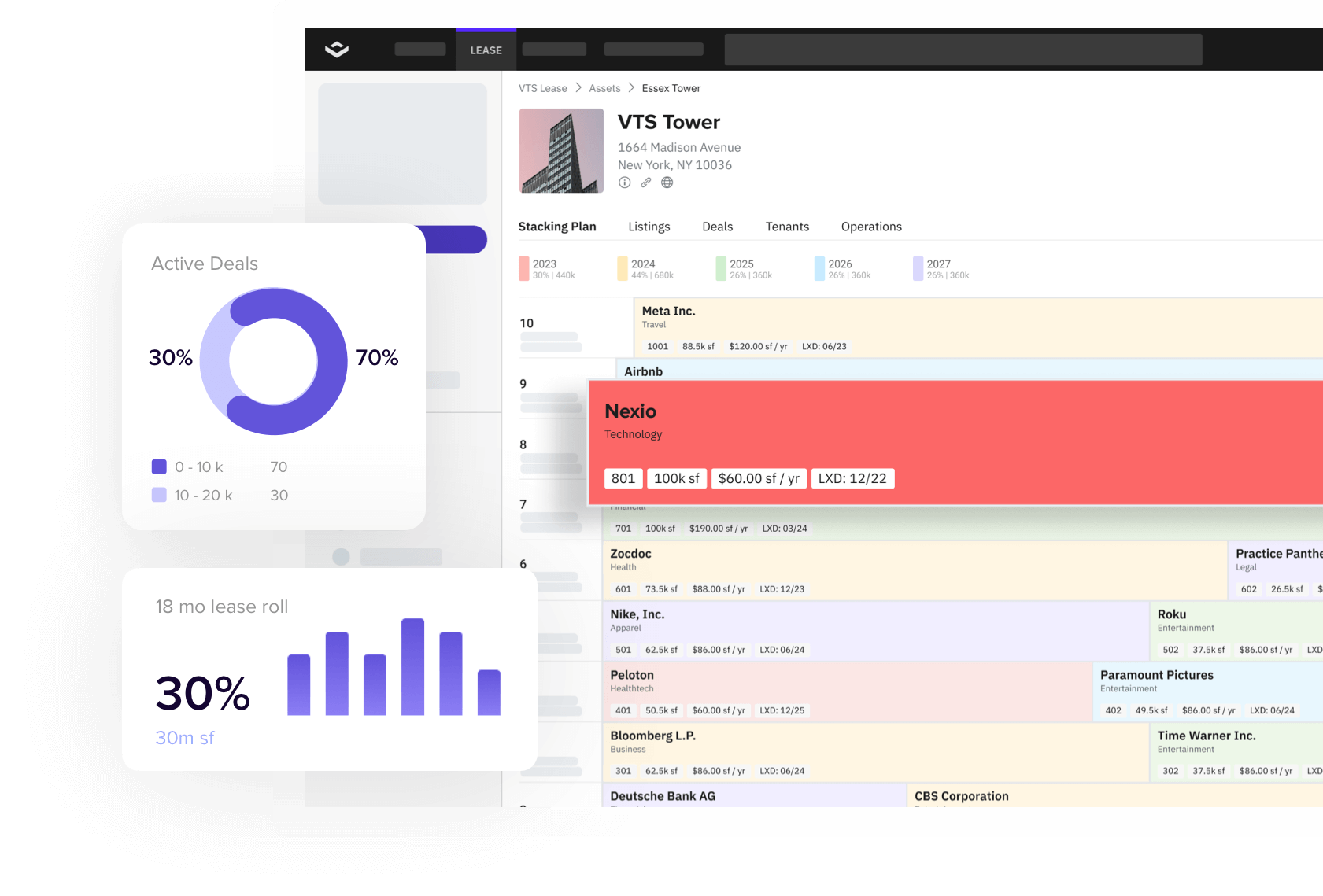
3. VTS
VTS is a major CRE platform for leasing, asset management, tenant demand, and market intelligence. It supports owners, operators, brokers, and asset teams that need better visibility into leasing activity, space availability, tenant behavior, and portfolio performance.
For CRE teams managing leasing and portfolio workflows at scale, VTS can help centralize activity and support more informed decisions around tenant demand, pricing, forecasting, benchmarking, and asset strategy.
The limitation is that VTS is a platform decision, not a lightweight AI add-on. It is most valuable when a firm has the portfolio complexity, leasing volume, and internal process maturity to support adoption.
The broader point is important: AI becomes more useful when it sits close to operational data. The more connected the leasing and asset data, the more valuable the intelligence layer becomes.
4. Reonomy
Reonomy supports property and ownership research. It helps CRE professionals identify commercial property owners, understand ownership structures, research properties, and source off-market opportunities.
For brokers, investors, lenders, and acquisition teams, this can improve prospecting and pre-call research.
The limitation is that property intelligence is not the same as execution. Finding a property owner or identifying a prospect is only part of the workflow. The next steps still need to happen in CRM, outreach, pipeline management, reporting, and follow-up.
This is where many firms lose value. Research happens in one tool, outreach happens in another, notes sit in email, and the CRM is updated later — if at all. AI and data tools are more valuable when insights can move directly into the systems where teams act on them.
5. CoStar
CoStar is one of the most established CRE information and analytics platforms. It supports market research, property data, comps, availability, tenant information, news, and industry intelligence.
For CRE professionals, it remains a key source of external market and property intelligence. It is relevant to AI conversations because large CRE data platforms are increasingly adding AI-enabled search, analysis, and user experiences.
But CoStar should not be described simply as a standalone “AI tool.” It is better positioned as a CRE data and intelligence platform that can support AI-enabled workflows when paired with the right internal systems and processes.
The practical point for firms is that external market data is only one layer. Teams still need to connect that intelligence with their own client relationships, deal history, property records, and pipeline activity.
6. Cherre
Cherre is a real asset data infrastructure platform. It helps firms unify property, portfolio, financial, and market data across systems so teams can support analytics, reporting, portfolio intelligence, and trusted AI workflows.
This makes Cherre different from tools that solve one visible task. It addresses a deeper problem: disconnected data.
For firms with complex portfolios, multiple systems, and fragmented reporting, data infrastructure can become the foundation for AI readiness. Without that foundation, AI tools may generate outputs faster, but not necessarily more reliably.
This is one of the most important lessons for CRE AI adoption: before firms automate decisions or reporting, they need to understand where their data lives, how reliable it is, and whether systems are connected enough to support trusted outputs.
CRM-Grounded and Agentic AI for CRE Workflows
The next stage of AI in commercial real estate is not just asking better questions or generating better drafts. It is AI that can work inside the systems where deals, relationships, properties, activities, and documents already live.
This is where CRM-grounded and agentic AI become important. The distinction is meaningful: generic AI tools generate outputs. CRM-grounded AI takes action on the data a firm has spent years building.
1. AscendixRe AI Suite: AI Built Specifically for CRE Brokers on AscendixRE
For CRE brokerage teams looking at a purpose-built CRM, or evaluating a move away from platforms that have gone quiet on AI, AscendixRE with AI Suite is the most complete option in this category.
AscendixRE is a commercial real estate CRM built on Salesforce, designed specifically for CRE workflows across tenant rep, agency leasing, investment sales, and managing brokerages. It handles contacts, properties, deals, leases, availabilities, stacking plans, commission tracking, and pipeline management, built on 25+ years of CRE-specific data modeling that generic Salesforce builds cannot replicate without starting from scratch.
AscendixRe AI Suite is the AI layer built directly into AscendixRE. It runs natively inside the broker’s existing Salesforce org, no new platform, no separate login, no data migration is needed. It addresses the two problems CRE teams describe most consistently: getting data into the CRM without manual entry, and getting answers back out without admin help.
The suite has four modules, each solving a different part of the CRE data problem.
- Brokers spend time switching between AI tools and the CRM. With AscendixRE Connector, ChatGPT and Claude have direct access to AscendixRE. Query deals, create contacts, and update records without opening the system. (Gemini support coming soon).
- Deal data lands in the inbox and never makes it to the CRM. Forward any deal email to Harvest and the contacts, properties, and lease terms arrive as draft records in AscendixRE, ready to approve.
- Searching records and logging updates means going back to a desk. Ask questions, log tours, and update deal stages by text or voice. AI Agent pulls from your actual CRM data.
- Client documents get rebuilt from scratch every time from data already in the CRM. Upload a branded template once and Composer AI connects it to live records. Open it and it is already populated.
The practical difference from a generic AI tool is grounding. The Conversational Agent knows the broker’s actual clients, deals, and pipeline — not general internet knowledge. That is what makes it useful inside a real brokerage workflow.
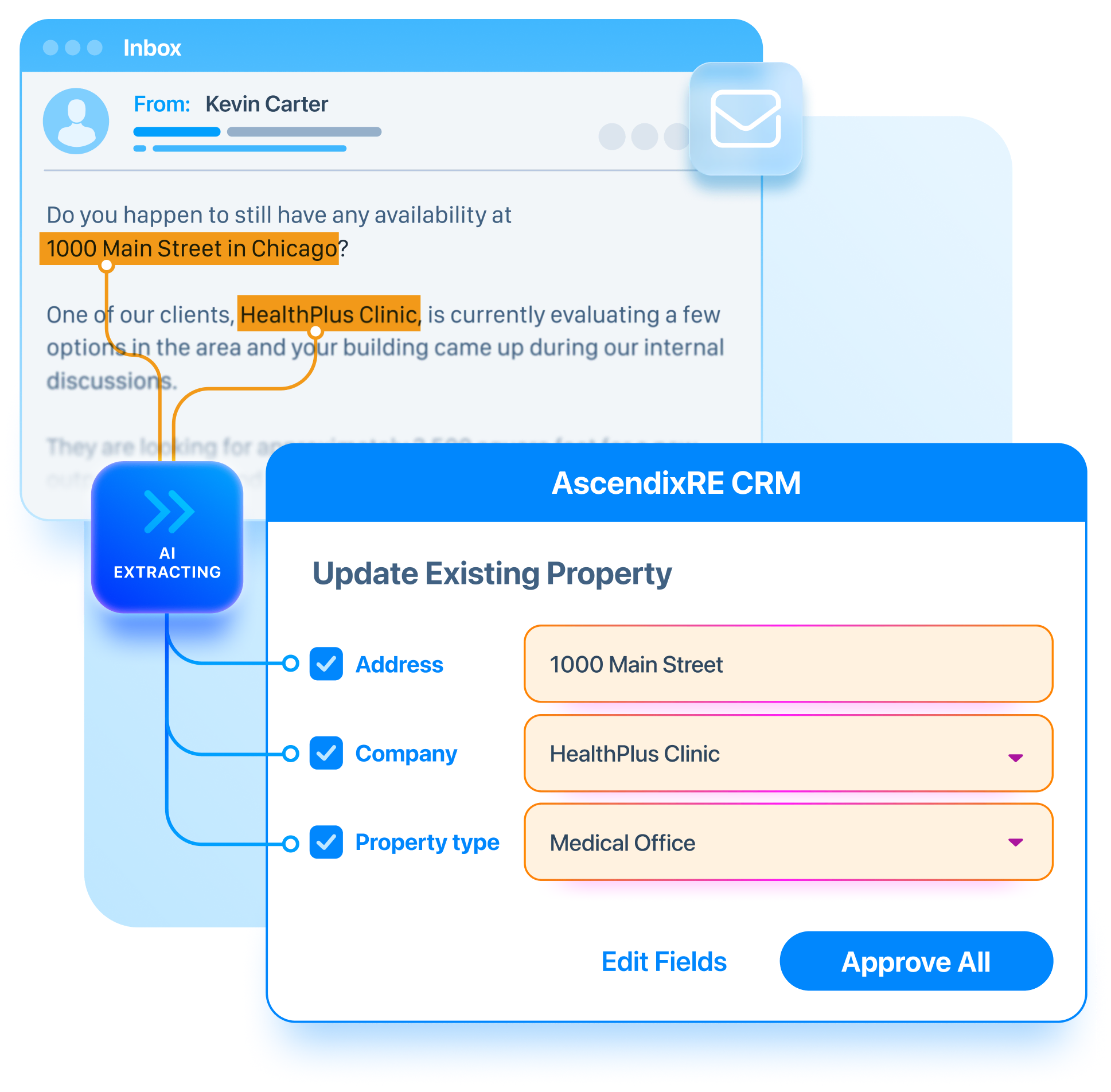 Harvest Email Parsing Tool for AscendixRE CRM
Book AscendixRE AI Suite Demo
See x=AscendixRE AI Suite in a 30-minute live walkthrough on sample data. Or send us a redacted broker sheet and we’ll run it through Harvest before the call so you see your own records on day one.
2. Agentforce
For commercial real estate firms already operating on Salesforce, Agentforce is the most direct path to agentic AI. It does not require data migration, new integrations, or a separate subscription.
Agentforce accesses CRM records, communication history, property data, deal pipelines, and task queues natively, and can execute autonomous actions across all of them. Practical applications include automatically updating deal stages after broker calls, surfacing expiring leases, drafting follow-up emails from meeting notes, and generating weekly pipeline reports without manual data entry.
Agentforce accesses CRM records, communication history, property data, deal pipelines, and task queues natively, and can execute autonomous actions across all of them. Practical applications include automatically updating deal stages after broker calls, surfacing expiring leases, drafting follow-up emails from meeting notes, and generating weekly pipeline reports without manual data entry.
Agentic AI for CRE by Ascendix
With agentic AI, you get more than just a chatbot. With Ascendix, you get industry expertise and a personalized approach.
Automation Platforms for Connecting AI to CRE Workflows
The most durable productivity gains do not come from individual AI-powered commercial real estate tools. They come from connecting those tools to the workflows where work actually happens. This is what we call the wrong-hours problem in CRE AI adoption: AI speeds up the cheap half of the work and leaves the expensive half exactly where it was.
Automation platforms are the connective tissue between AI capabilities and daily operations.
Two platforms stand out for CRE firms:
- Make (formerly Integromat): a visual, no-code automation builder that connects CRE systems, CRMs, document tools, and AI APIs. Ideal for firms that want sophisticated multi-step workflows without an in-house developer.
- n8n: an open-source, self-hostable alternative suited to technical teams. Supports multi-step AI agents, real-time data integration, and custom logic in JavaScript or Python across 400+ integrations.
These platforms create workflow automations that trigger on real events: a new property record, a signed lease, a contact update. They are not agents in the technical sense. They are deterministic workflows that incorporate AI steps. For most mid-market CRE firms, they deliver more measurable ROI than building a custom AI agent from scratch.
Agentic Coding
One of the most important but less discussed shifts in AI is the sharp drop in the cost of custom software development through agentic coding. AI systems that can plan, write, test, and debug code with minimal human input have fundamentally changed what mid-sized firms can now build.
“ A year ago, a custom project with high-volume data processing and complex logic might easily be a $5 million engagement. Today, with agentic coding, the same scope can be delivered for less than $1 million. That's not hype. This is the project that we're already doing. ”
Arthur Ambartsumyan, Technology Director, Ascendix
This shift is democratizing CRE technology. Mid-market firms can now build data infrastructure and AI tools once limited to firms like JLL and CBRE. The gap between enterprise and mid-market capability has narrowed.
Tools like Lovable.dev let non-technical users build working applications with databases and authentication from simple text prompts, without a development team.
Why Most AI Tools Fall Short in CRE?
Most CRE firms are not failing at AI because they chose the wrong tool. They are failing because the data underneath the tool is not ready.
- Property records scattered across legacy spreadsheets, email attachments, and aging CRMs;
- Duplicate contacts with conflicting data across systems;
- Rent rolls in inconsistent formats, deal notes in email threads;
- No single source of truth for key assets.
This is why the most important AI question for a CRE firm is not “which tool should we buy?” It is “are we ready to use it well?”
Where most mid-market CRE firms stand today:
| Stage | What It Looks Like | Typical Tools |
| Stage 1: Experimenter | Individuals using AI ad hoc for emails and research | ChatGPT, Claude, Copilot |
| Stage 2: Integrator | AI connected to specific productivity workflows | Copilot, NotebookLM, Gamma |
| Stage 3: Automator | Agents handling repetitive tasks end-to-end | Agentforce, xRe AI Suite, Make |
| Stage 4: AI-First Firm | Decisions driven by unified, AI-ready data | Custom integrations, Cherre, CRE platforms |
Most mid-market CRE firms are at Stage 1 or Stage 2. Getting to Stage 3 is not a software purchase, it is a workflow and data project. Ascendix has spent 25+ years working inside commercial real estate technology, building CRM systems for brokers, implementing Salesforce for CRE firms across every specialty, and more recently advising on AI strategy and implementation for teams navigating exactly this transition. We have seen what happens when firms deploy AI on clean, well-structured data. We have also seen what happens when they do not.
What a Data Readiness Audit Covers
- Current state mapping: where does your data live, in what format, and who owns it?
- Quality assessment: duplicates, missing fields, format inconsistencies.
- Integration gaps: which systems don’t talk to each other?
- AI readiness scoring: which workflows are ready for AI automation today vs. in 6–12 months?
- Prioritized roadmap: quick wins (high value, low complexity) vs. foundational investments.
Ascendix works with CRE firms as a strategic partner in exactly this capacity: not just as a software vendor but as the firm that ensures your data is ready before you invest in AI tooling. Because without that foundation, even the best AI platforms will underperform.
Getting Old-School Brokers to Actually Use AI Tools
Technology adoption in commercial real estate has always been an uphill challenge. Brokers are relationship-driven, schedule-constrained, and in many cases skeptical of anything that changes a workflow that has worked for 20 years.
Getting CRE Teams to Actually Use AI
- Deploy AI inside existing tools. Agentforce inside Salesforce, Copilot inside Outlook. Brokers do not adopt new platforms. They adopt new features in platforms they already use daily.
- Start with friction-removers, not capability-adders. ‘This eliminates the two hours you spend updating deal notes after calls’ is a better pitch than ‘this AI can generate 50 property reports.’
- Use peer champions. Find the two brokers who are already experimenting with AI. Give them the tools and structure, then let them demo wins to the team.
- Measure and share time savings. Concrete examples convert skeptics faster than any strategy deck. ‘This OM took 45 minutes instead of 4 hours’ is more persuasive than a features comparison.
- Acknowledge the learning curve honestly. AI tools are not plug-and-play for CRE workflows. Firms that build in structured onboarding and ongoing support see three to five times the adoption rates of those that don’t.
Bottom Line
The question is no longer whether to use AI in commercial real estate. It’s whether your firm has the data infrastructure to use it well. The tools exist. The cost has come down. The competitive pressure is real.
Once that foundation is clear, the next step is not to adopt everything at once, but to be deliberate about where AI fits into your workflow.
- Start small and focused: Begin with one high-impact area such as lead generation, marketing, or administrative work.
- Fit into existing systems: Choose tools that integrate with your current workflow instead of forcing process changes.
- Plan for adoption costs: Factor in both subscription pricing and the time needed for teams to learn and adapt.
- Think in workflows, not tools: AI should become part of daily operations, improving efficiency and deal execution over time rather than sitting as standalone software.
How Ascendix Can Help
Ascendix is a commercial real estate technology partner with 25+ years of CRE domain experience, 150+ Salesforce certifications, and a track record of building and implementing AI solutions for brokerages, capital markets teams, and investment firms.
We work with CRE firms across four areas:
CRM built for CRE, with AI included. AscendixRE with AscendixRe AI Suite gives brokers a purpose-built CRM on Salesforce with AI that captures deal data from email, answers plain-language CRM queries, and generates branded documents from live records. No migration, no new platform — it works on the data you already have.
Agentforce implementation. As a Salesforce Summit Partner and Agentforce Partner Network member, we implement AI agents inside your existing Salesforce org. The Quickstart package gets your first agent live in 2–3 weeks.
AI strategy and consulting. Not sure where to start? We assess your data, map your workflows, and tell you which AI investments will deliver in the near term and which need groundwork first.
Talk to Ascendix about AI for commercial real estate
What is the best AI tool for commercial real estate in 2026?
There is no single best tool. It depends on your use case and tech stack. ChatGPT and Claude are strong for research and writing. Agentforce fits Salesforce users. NotebookLM works best for Google Workspace, and Microsoft Copilot for Microsoft 365. CRE-specific tools like VTS, Reonomy, and Henry AI focus on deal workflows. Start with your existing data setup.
How is agentic AI different from generative AI in CRE?
Generative AI creates content like emails or summaries. Agentic AI executes tasks, such as updating CRMs, pulling data, or flagging issues. In 2026, agentic AI is where most productivity gains are happening.
Why is data readiness so critical before deploying AI in CRE?
AI only works as well as the data behind it. If your data is fragmented, duplicated, or inconsistent, outputs will be unreliable. Clean, structured data is the foundation for any successful AI use.
What is commercial real estate underwriting with AI?
It uses AI to speed up cash flow modeling, rent roll analysis, lease abstraction, and scenario testing. It reduces manual work and improves consistency in underwriting.
How do I get my brokers to actually use AI tools?
Start with tools inside systems they already use, like CRM, email, and Teams. Focus on small workflows that save time immediately. Adoption improves when value is visible in daily work, not through top-down mandates.
Darina Milova , Content writer
Darina creates compelling content about Salesforce products, Ascendix services, and CRM best practices. Her articles provide valuable tips and insights and help readers stay abreast of the recent trends in the commercial real estate industry.



 (30 votes, average: 4.89 out of 5)
 Loading...