Ask a brokerage operations manager where the commission numbers live, and the answer is often a spreadsheet rebuilt every month because the system cannot produce the report leadership wants.
That spreadsheet is the trigger. So are matching invoices to payments by hand, keying the same deal into a CRM and a commission tool, and answering the Friday message from a broker who wants to know when a closed deal becomes a check.
Key Takeaways:
- Judge commission software on plan depth, invoicing, payout visibility and reporting, not just on whether it calculates a split correctly.
- AscendixRE keeps Commission Tracking inside the CRE CRM, so deal data, tiered plans, invoices and broker payouts share one record.
- Standalone back-office and incentive-compensation tools work well, but price the integrations, duplicate data entry and CRE configuration work they require.
- AI belongs on top of trusted commission data. AscendixRE AI Suite lets ChatGPT and Claude query AscendixRE commission records directly.
In this article, we’ll take a look at seven alternatives to Yardi CommissionTrac and CommercialEdge Commissions. You’ll find the one that fits how your brokerage handles splits, invoices, and payouts, whether that points to a CRE CRM with built-in commission processing.
How We Evaluated Yardi CommissionTrac Alternatives for CRE
A feature checklist that reads “supports commissions: yes” tells a brokerage almost nothing. Every product on this list calculates a split. The difference shows up in where standard logic ends, what happens to the money after the calculation, and how much re-entry the operations team absorbs each month. We used eight criteria:
- Commission-plan depth. Broker-based tiering, house splits, changing fee schedules, referral fees, effective periods, and structures that are not a flat percentage.
- Back-office workflow depth. Whether the product goes past split math into invoicing, receivables, payments, vouchers, approvals, payout visibility, and reporting.
- CRM and data relationship. Whether commission data is native to the same system as deal and pipeline data, connected by integration, or held in a separate back-office product. What has to be keyed twice.
- CRE specificity. Whether the product understands brokerage deals and compensation, or is a general sales-comp or accounting platform that needs translation.
- Configurability and services. Whether unusual plans and reports can be adapted without rebuilding, and whether the implementation team knows brokerage compensation.
- Reporting and payout visibility. Whether brokers, operations, and leadership can see earned, invoiced, received, owed, and expected without a side spreadsheet.
- AI and data accessibility. Whether structured commission data can be queried through modern AI interfaces, grounded in the system of record.
- Migration, implementation, and total cost. What historical data moves, what the license covers, and what needs services, integrations, or separate products.
For background on how these calculations work in practice, see our commercial real estate commission tracking guide.
The 7 best Yardi CommissionTrac alternatives for CRE brokerages in 2026
-
AscendixRE
Best for: mid-market and full-brokerage CRE firms with an acute commission problem that also want structured deal and relationship data in the same system.
AscendixRE commercial real estate CRM has CRM-native commission processing inside it. Commission Tracking is part of the Enterprise plan rather than a separate Ascendix commission application, so deal records, commission calculations, invoices, and payouts sit in one system of record.
What the standard commission model covers:
- Tiered broker plans. Production moves through tiers to determine the broker’s house split.
- Variable commission fee structures. The fee percentage changes across periods of a multi-year lease instead of holding flat for the full term.
- Gross deal and gross fee logic. The workflow uses the underlying deal economics to derive gross deal value, average gross fee percentage, and gross fee amount.
- Invoices, payments, and vouchers*. Invoices, the payments recorded against them, and payment vouchers sit in the same structured data set that feeds reporting.
Where it differs from a standalone back office?
The CRM layer matters even to a commission-first buyer. The same deal record supports pipeline, relationship history, and reporting, which removes a re-entry step and gives brokers a practical reason to keep records current, since accurate deal data is what gets them paid.
Territory-based plans are not standard out of the box. The architecture is flexible enough to configure them, and the Ascendix services team works in brokerage compensation terms rather than asking the firm to translate CRE logic for a general software implementer. Firm-specific rules, special fee schedules, and unusual splits fall into this category.
AI layer is available with the AscendixRE Connector (part of AscendixRE AI Suite). Users can query commission-related CRM data in ChatGPT or Claude, including expected payment dates on recently closed deals, payments, and others.
What it brings you is one less queue. Brokers answer their own payment questions, operations stops running the same lookup ten times a week, and leadership sees payout status without asking for a report.
For example, a broker asks Claude when they get paid on the Lincoln Tower deal. The answer comes back from live CRM data before they would have finished the email to operations. Invoice sent on the 3rd, client paid on the 14th, voucher approved, payout on the next run. The Connector reads what the commission engine has already produced, so the calculation logic stays in AscendixRE.
The commission logic stays in AscendixRE, and the AI layer queries what the commission engine has already produced.
“ By connecting your AscendixRE environment to the AI model your team already uses, every record, every listing, every deal, and every contact becomes a live input to an intelligent assistant that can research, write, report, and act on demand. No new platform to learn. No data migration. Your CRM gets smarter overnight. ”
Wes Snow , CEO at Ascendix Technologies
Pricing. The current AscendixRE pricing for AscendixRE Enterprise is $99/month with Commission Tracking included. The AI Suite is priced separately.
Your commission report should not live in a spreadsheet
See how AscendixRE handles tiered splits, variable fee structures, invoices, payments, and broker payouts in one CRE system of record.
-
Buildout Manage & Close
Best for: brokerages already operating in Buildout or evaluating the wider platform.
Buildout is purpose-built for commercial real estate, and Manage & Close covers the transaction and back-office side: commissions, splits, invoices, approvals, payouts, and reporting. Buildout’s current positioning describes its products running on one shared data layer across the suite, so a firm already using Buildout for marketing and pipeline gets commission processing against records it already maintains.
Where it differs from a CRM-native approach?
Buildout sells its solutions individually. A brokerage that needs commission tracking and a CRM buys two subscriptions, two renewals, and a platform maintenance charge on top. The data layer is shared, so this is packaging rather than an integration problem. It still decides what you pay.
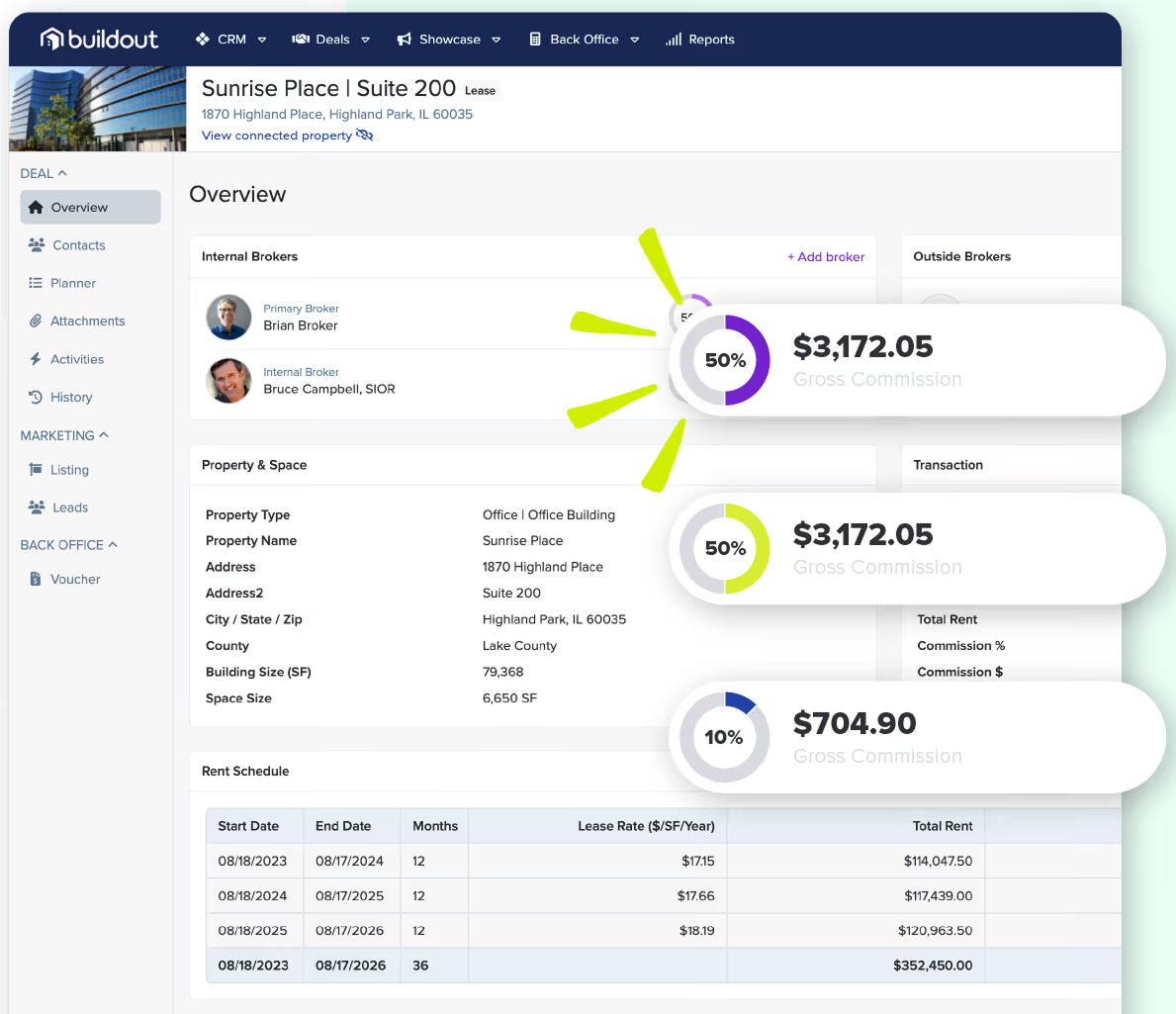
Buildout Manage & Close | Source: Buildout
Buildout’s pricing starts at $125/user/month, based on seat count plus platform maintenance. Module-level pricing is not published and sits behind a form, so re-check any per-broker figure from an older comparison against a current quote. A brokerage buying both CRM and commission tracking from Buildout pays for two solutions plus the platform fee.
The same brokerage on AscendixRE pays for one Enterprise subscription at $99/month, with commission tracking and invoicing included.
-
Dealius
Best for: CRE brokerages that want a dedicated commission and back-office specialist, particularly where RealNex is already in the stack.
Dealius is brokerage management software built around the commercial back office: commissions, invoicing, receivables, payables, and cash flow. RealNex publishes an official Dealius integration page, so firms running RealNex as their CRM can pass deal data into Dealius for commission processing rather than rekeying it.
Where it differs from a CRM-native approach?
Dealius includes its own CRM essentials, but its integration with RealNex still connects two distinct platforms rather than extending a single CRM. That distinction matters for firms using both systems, as they need to manage data synchronization, reconcile records across platforms, and report from two connected applications. For firms with an established CRM strategy, that trade-off may be worthwhile. For organizations replacing both their CRM and back-office systems at the same time, a unified platform can reduce complexity and ongoing administrative effort.
Pricing note: Dealius pricing combines recurring licenses with a one-time onboarding fee and is quote-based.
-
Lone Wolf Back Office
Best for: brokerages where accounting, trust management, payroll, and escrow drive the software decision more than deal workflow does.
Lone Wolf’s back-office stack is deep on the accounting side of a real estate brokerage: general ledger, commissions, trust management, and operational reporting in one product. Firms that need their commission system to double as their accounting system, and whose controller has strong requirements, tend to shortlist it early.
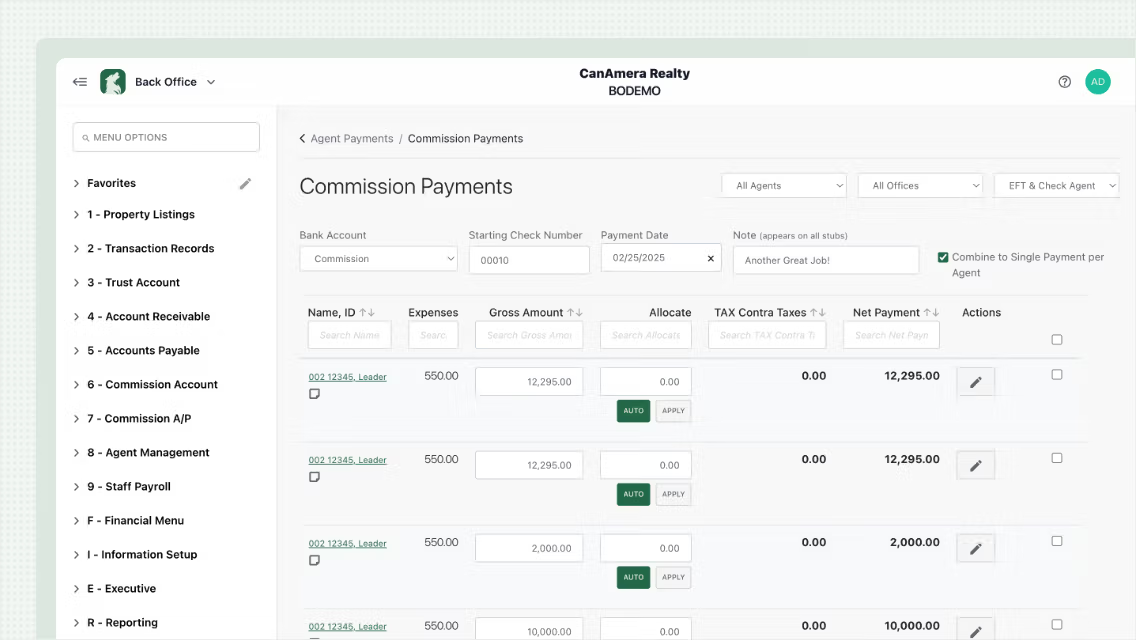
Where it differs from a CRE CRM-native approach?
Lone Wolf serves real estate broadly rather than commercial brokerage specifically. The deal workflow that a CRE operations team recognizes, with lease terms driving fee schedules and variable percentages across a multi-year term, is not the center of the product. Firms operating across several states or provinces should confirm jurisdiction-by-jurisdiction trust-accounting coverage with Lone Wolf directly.
Pricing of Lone Wolf is quote-based.
-
BoldTrailBackOffice (Brokermint)
Best for: high-volume residential or general real-estate brokerages that need transaction management, commission automation, and accounting together.
Brokermint, now part of BoldTrail, handles unlimited commission plans, splits, sliding scales, caps, and fees, alongside transaction management, accounting, and reporting. For firms processing large deal volumes with many plan variations, the automation depth is real.
Where it differs from a CRE CRM-native approach?
The company positions Brokermint as residential real-estate back office. A commercial brokerage evaluating it should treat it as an adjacent option rather than a CRE-native peer, and should test lease-driven fee schedules and CRE deal structures directly rather than assuming coverage. Firms with both residential and commercial arms sometimes land here for the residential side and keep a separate CRE system.
Pricing is not publicly available. Contact the vendor for a custom quote.
-
Loft47
Best for: brokerages prioritizing commission accounting, compliance, and transaction administration.
Loft47 covers commission management and split automation, payout workflows, compliance and document tracking, and integrations into accounting systems. Operations teams that spend most of their month on payout accuracy and document compliance get a product built around exactly that.
Where it differs from a CRE CRM-native approach?
Loft47 presents itself as a broad real-estate back office rather than a CRE specialist, so a commercial firm should put its own lease-driven fee schedules in front of the product during the demo. There is no CRM layer here either, so pipeline, relationship history, and deal reporting stay wherever they already live.
Pricing for plans varies. Get in touch with the team to choose your fit.
Looking For a Better Way to Track Commissions?
See how AscendixRE helps brokerages manage splits, deductions, and payouts in one connected CRM.
-
Salesforce Spiff
Best for: organizations evaluating a general enterprise incentive-compensation engine rather than CRE brokerage software.
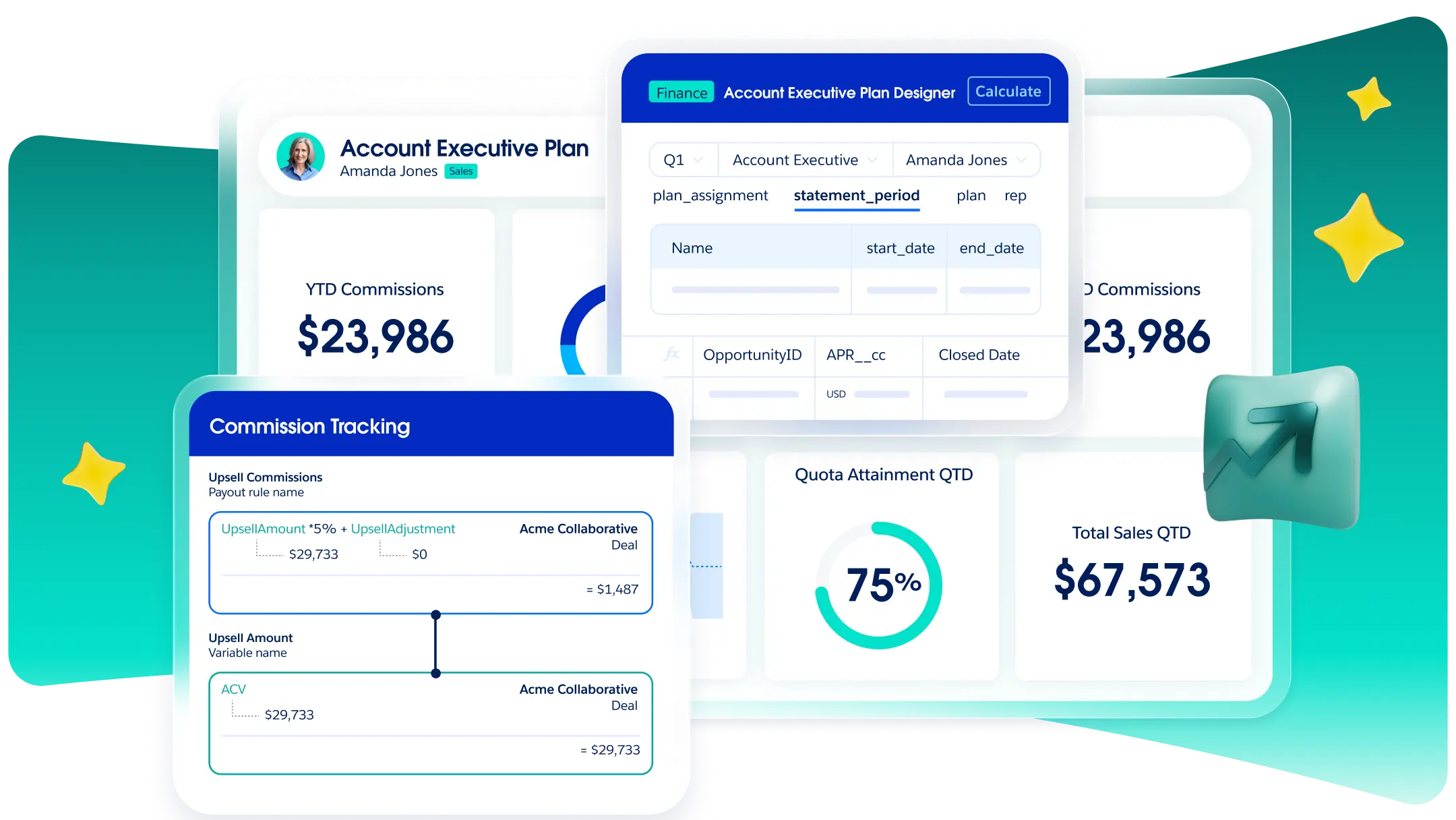
Spiff manages commission plans at scale: tiers, approval workflows, audit trails, rep statements, and reporting. As a compensation engine it is capable, and firms with large mixed sales organizations sometimes need exactly that breadth.
Where it differs from a CRE CRM-native approach?
Spiff models incentives. A brokerage still has to translate commercial real estate deal logic into it, and the brokerage back office, invoices raised against clients, payments received, and payment vouchers issued to brokers, is not covered by default. That translation is a project in its own right, and it usually pulls in adjacent systems to close the gap.
Pricing is $75/user/month billed annually, with additional connectors priced separately.
How to Choose the Right Alternative for Your Brokerage
There is no universal winner here. The right answer follows from what is already in the stack and where the pain sits.
| Your situation | Shortlist direction | Why |
| You want commission processing and CRM in one CRE system | AscendixRE | Commission is the immediate pain, but the firm also wants structured deal and relationship data, configurability, and optional AI access. |
| You already operate heavily in Buildout | Buildout Manage & Close | Buildout positions its products on a shared data layer. Evaluate total package scope and get a current quote. |
| You use a CRM like RealNex and want a dedicated CRE back office | Dealius | The official RealNex integration makes this a logical pairing. |
| Accounting, trust, and back-office operations are the centre of the decision | Lone Wolf or Loft47 | Compare accounting and compliance depth against what you give up on CRE brokerage CRM. |
| You are a high-volume residential or general real-estate brokerage | BoldTrail BackOffice | Strong adjacent back office, less CRE-specific. |
| You need general enterprise incentive compensation across sales teams | Salesforce Spiff | Capable horizontal compensation engine, but CRE brokerage workflow still needs translation and adjacent systems. |
What to Check Before you Migrate Commission Data
Migration scope drives timeline and cost, and it is the part most often underestimated. Four questions set the number.
- How muchhistoryhas to move?
Decide how many years of closed deals, invoices, payments, and vouchers come across, and whether historical splits need to reproduce exactly or can be archived as records. In-flight deals cause more trouble than closed ones, because a deal invoiced in the old system and paid in the new one has to reconcile across both.
- How many distinct broker plans are in use?
Count every plan running today, including the exceptions negotiated with individual brokers, and mark each one as standard or configured in the new product. That line is where implementation quotes move.
- Which reports will leadership not give up?
Commission reporting is where a migration gets judged internally. A report the CFO reads every month is a requirement, and it belongs in the evaluation rather than in a post-launch backlog.
- What sits inside the license, and what is aservicesengagement?
Ask each vendor to place three items on one side of that line or the other: accounting integrations, custom reports, and firm-specific compensation logic. Compare both numbers, not the subscription alone.
For more insights, go to our commercial real estate commission tracking software guide.
What’s Next
Most brokerages start this search to fix commission processing and finish it by choosing a system of record. If the goal is one CRE operating platform covering deal data, commission calculation, invoicing, payment, and payout visibility, look at AscendixRE Commercial Real Estate CRM and bring your two most awkward broker plans to the demo.
Looking For a Better Way to Track Commissions?
See how AscendixRE helps brokerages manage splits, deductions, and payouts in one connected CRM.
What To Know About Commission Tracking
What is the best alternative to Yardi CommissionTrac for a commercial real estate brokerage?
There is no universal best tool. AscendixRE is strongest when a brokerage wants commission processing and structured CRM data in one CRE platform. Buildout and Dealius are strong CRE-native alternatives, and accounting-led firms often prefer a dedicated back-office product such as Lone Wolf or Loft47.
Should a CRE brokerage use standalone commission software or a CRM with commission tracking?
Use a standalone tool when back-office processing is the only priority and the CRM decision is already settled. Use CRM-native commission tracking when the same deal data should support pipeline, relationships, reporting, payouts, and future AI use without maintaining a second operating record.
Can AscendixRE handle tiered broker commission plans?
Yes. Broker-based plans where production moves through tiers to determine the broker’s house split are part of the standard commission workflow.
Can AscendixRE handle commission fee percentages that change during a multi-year lease?
Yes. The commission model supports variable fee structures across different periods of a lease and uses those periods in gross fee calculations, rather than assuming one flat fee for the full term.
Can brokers ask ChatGPT or Claude when they are expected to get paid?
With AscenixRE AI Suite and AscendixRE Connector, commission-related CRM data can be queried in ChatGPT or Claude. Expected payment dates on recently closed deals are one confirmed example, alongside invoices, payments, and payment vouchers.
Ascendix Team
We are a team of CRM consultants, developers, data analysts from the United States and Europe. Since 1996, we've been helping companies make the most out of CRM software and improve their software systems.



 Loading...