Looking For a Better Way to Track Commissions?
See how AscendixRE helps brokerages manage splits, deductions, and payouts in one connected CRM.


Commercial real estate commission tracking should be simple. In many brokerages, it isn’t.
Commercial real estate commission tracking is the process of calculating, allocating, and monitoring broker compensation across the life of a deal. In practice, that can include co-broker deductions, analyst participation, house splits, tiered plans, invoicing, and payment tracking.
Commercial real estate also adds more complexity than many generic commission tools are built for. One deal may use a flat percentage. Another may depend on lease terms. Another may be calculated by dollars per square foot. Another may involve multiple deductions before the final payout is determined.
That is why commercial real estate commission tracking is best understood as a workflow, not just a calculator.
In this guide, we’ll cover:
Commercial real estate commission tracking is the process of recording how compensation is earned, split, adjusted, and paid across brokerage deals.
That usually includes:
In other words, commission tracking is not only about the final payout. It is about maintaining a reliable record of how compensation moves from deal economics to broker payout.
For CRE firms, that matters because compensation structures are often more nuanced than in standard residential models. Firms may need to account for lease commissions, investment sales, team-based participation, special deductions, and broker-specific plans in the same system.
Ascendix works with CRE brokerages every day, and this math is one of the most common places we see teams trip up, which is why AscendixRE was built to handle commission tracking as part of the core CRM, not as a bolt-on.
If you’re evaluating commission tracking software rather than calculating splits by hand, see our comparison of the best CRE commission tracking platforms.
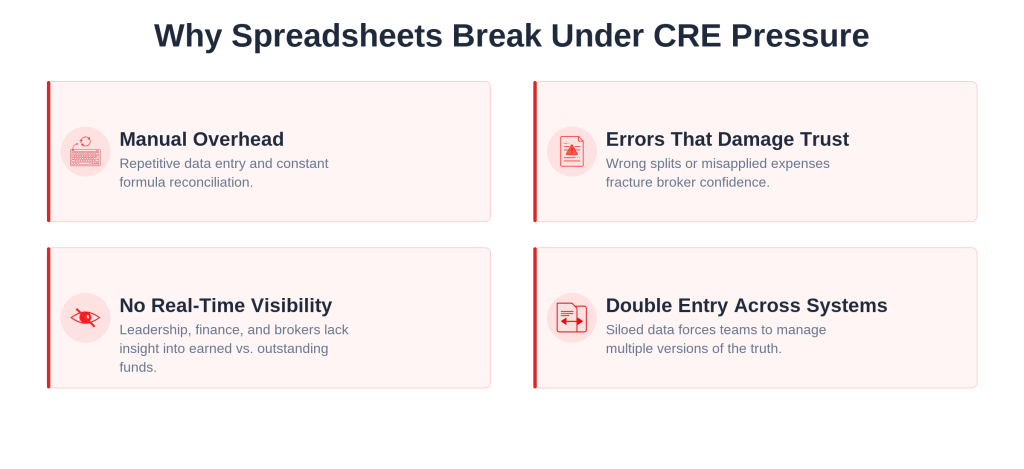
Why Spreadsheets Break Under CRE Deal Pressure
Spreadsheets are often the first system brokerages use for commission tracking because they are easy to start with. But they become fragile as deal volume, broker count, and compensation complexity increase.
Someone has to enter deal data, update formulas, track split changes, and verify final numbers manually. That is time your operations team should not be spending on repetitive reconciliation.
Broker commissions are sensitive. If a split is wrong or an expense is applied incorrectly, the issue is not only financial. It affects broker confidence in the process.
Leadership, finance, and brokers all need visibility into what has been earned, what has been deducted, and what is still outstanding. Spreadsheets make that harder.
This is where many brokerages run into a bigger structural problem. If deal data lives in one CRM and commission tracking lives in another tool or spreadsheet, teams end up re-entering information, reconciling discrepancies, and managing multiple versions of the truth.
That is why the real decision is often not only which tool can calculate commissions, but whether commission tracking should live inside the broader CRM workflow.
For many CRE firms, one connected system from deal to payout is more reliable than managing commissions in a separate silo.
This is also where a lot of the “manual overhead” problem above actually lives. In AscendixRE, commission plans can use dynamic tiered house splits that update automatically as a broker crosses a year-to-date production threshold, rather than someone maintaining a lookup table by hand and re-checking it every time a broker’s numbers change.
Commercial real estate commission tracking is usually a multi-stage financial workflow. A reliable process often includes four stages:
This can be based on a flat percentage, a lease-term structure, a dollar-per-square-foot model, or a flat amount.
Before inside splits are finalized, firms may need to account for co-broker fees, referral fees, marketing expenses, analyst participation, or transaction-related costs.
The house split may depend on the broker’s compensation plan, year-to-date production, or tiered thresholds rather than a fixed percentage.
The final step is not just “calculate and forget.” Brokerages still need visibility into invoicing, payment status, voucher distribution, and reporting.
This is why many teams eventually outgrow spreadsheets. The challenge is not only math. It is managing a connected workflow accurately and consistently across the life of the deal.
To make that workflow more concrete, let’s look at how commission tracking is typically structured inside a CRE CRM. The examples below use AscendixRE to show how brokerages can track commission roles, payout order, and deal-level calculations in practice.
In practice, commercial real estate commission tracking usually involves several participant types on a deal. In AscendixRE, these roles can be tracked through separate commission records so brokerages can calculate payouts more consistently and report on them more clearly.
Analyst − an Account or Contact acting as an Analyst for the Deal.
Co-Broker − an Account or Contact for a broker outside of your company that worked on the Deal and will receive a portion of the commission.
Expense − expenses related to closing the Deal such as marketing expenses, referral fees, etc.
Inside Broker − a User within your company who worked on the Deal and will receive a portion of the commission.
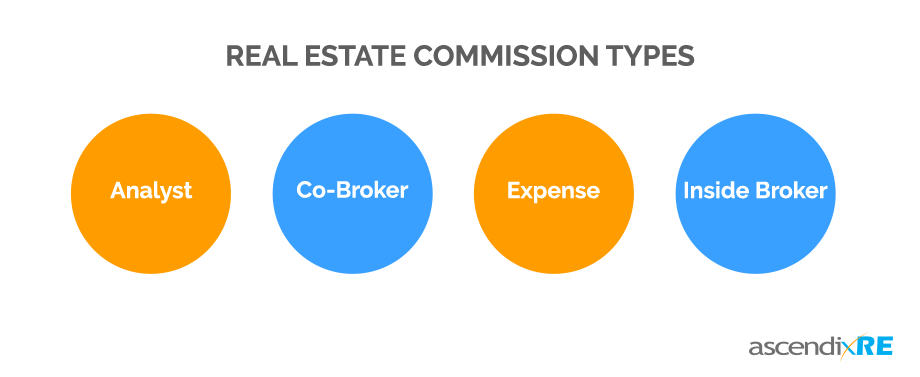
Real Estate Commission Types
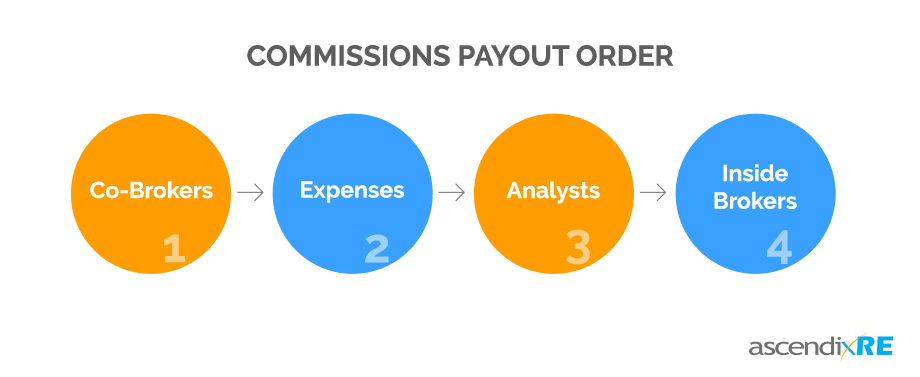
Real Estate Commissions Payout Order
If Inside Brokers have expenses, they will be subtracted from their total commission.
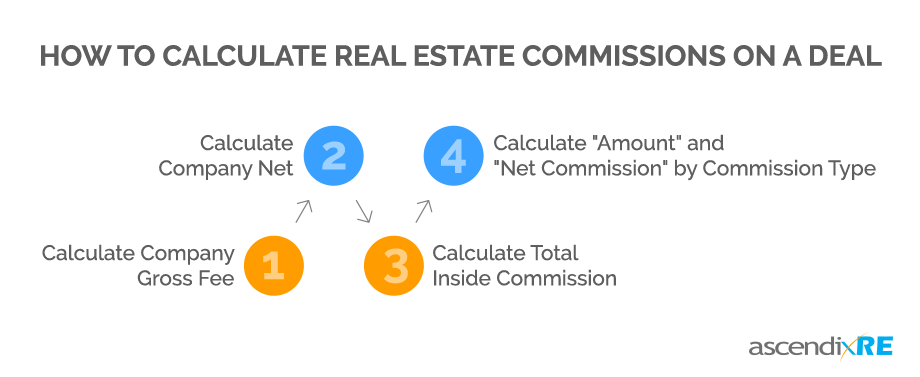
How to Calculate Real Estate Commissions on a Deal
The examples below show how these calculations can be tracked inside AscendixRE, a commercial real estate CRM built on Salesforce.
The Company Gross Fee calculation gets the “Gross Fee Amount” from the Deal
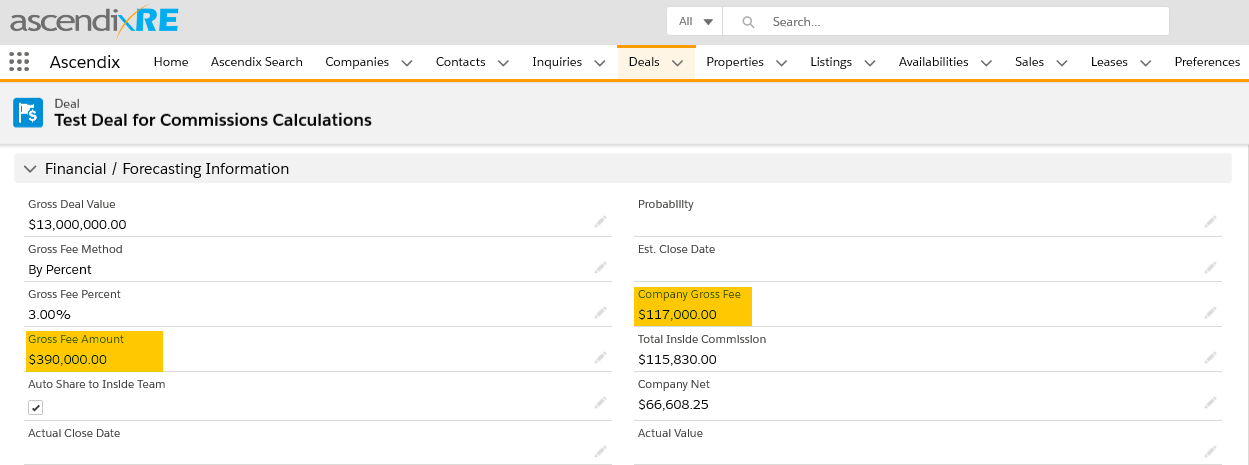
How to Calculate Company Gross Fee
as well as all the Co-Broker commission split records from this Deal. The calculation is:
Company Gross Fee = Gross Fee $ * (1 – Sum (Co-Broker Split %))
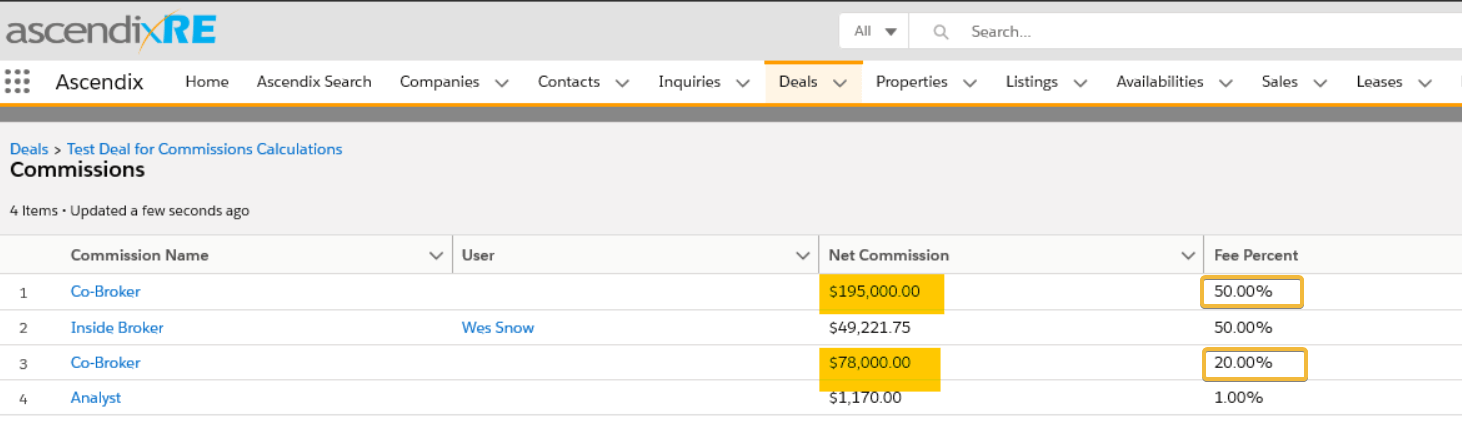
How to Calculate Co-Broker Split
The result from this calculation will be written back to the Company Gross Fee field on the Deal and will be shown as read-only. “Company Gross Fee” formula fields on all commission records tied to this Deal.
See how AscendixRE helps brokerages manage splits, deductions, and payouts in one connected CRM.
“Company Net” calculation gets the “Gross Fee Amount” and the “Company Gross Fee” and the following groups of commission records for this Deal:
Deal Expenses − the “Amount” total from all “Expense” commission records for this Deal.
Analysts − the “Amount Percent” total from all Analyst commission records for this Deal. The total percentage for the Analysts is taken from the “Company Gross Fee” to add to the Deal Expenses total.
Inside Broker’s Net Commission – to track this commission you need to consider the following calculations: Inside Broker Split %, House %, Direct Expenses, and Other Expenses.
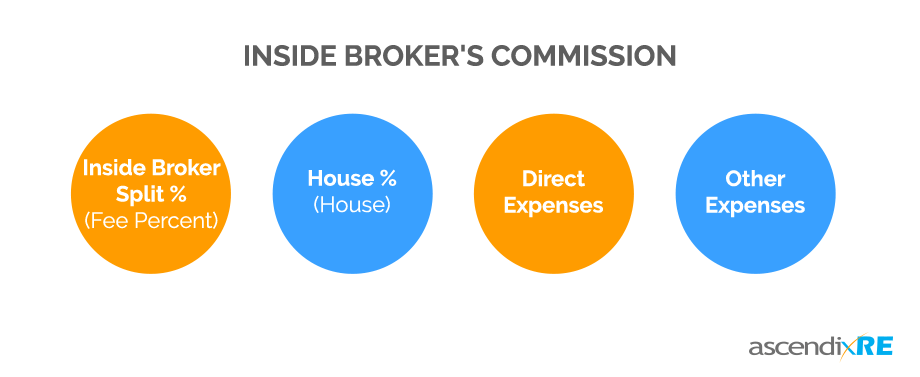
Inside Broker’s Commission
How to calculate Inside Broker’s Net commission:
Inside Broker’s Net commission = Fee Percent – House – Direct Expenses – Other Expenses
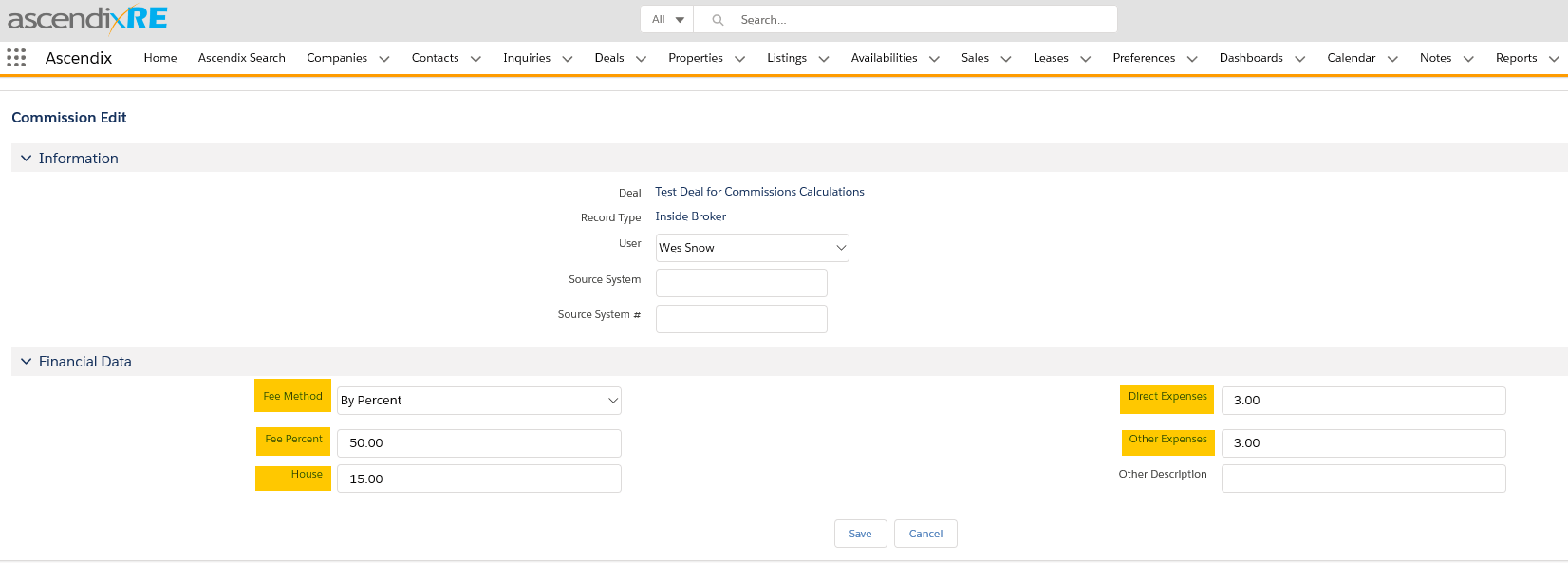
How to Calculate Inside Broker’s Net Commission
The Company Net calculation is:
Company Net = Company Gross Fee – Deal Expenses – (Analysts and Inside Brokers Net Commissions)
The “Company Net” field is read-only and calculates upon save when any of the values above are changed.
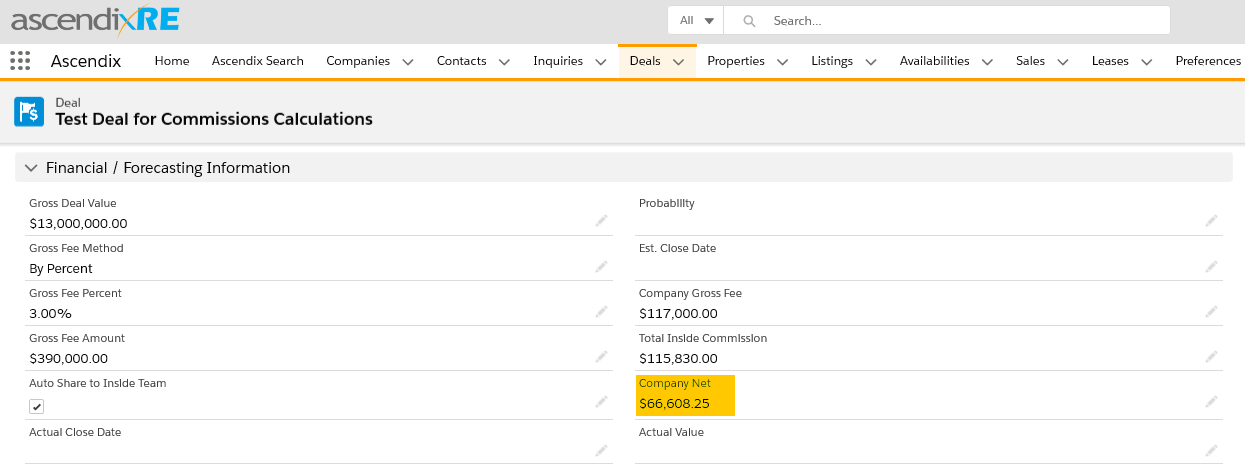
How to Calculate Company Net
The Total Inside Commission is calculated as:
Total Inside Commission = Company Gross Fee - (Deal Expenses and Analyst commissions).
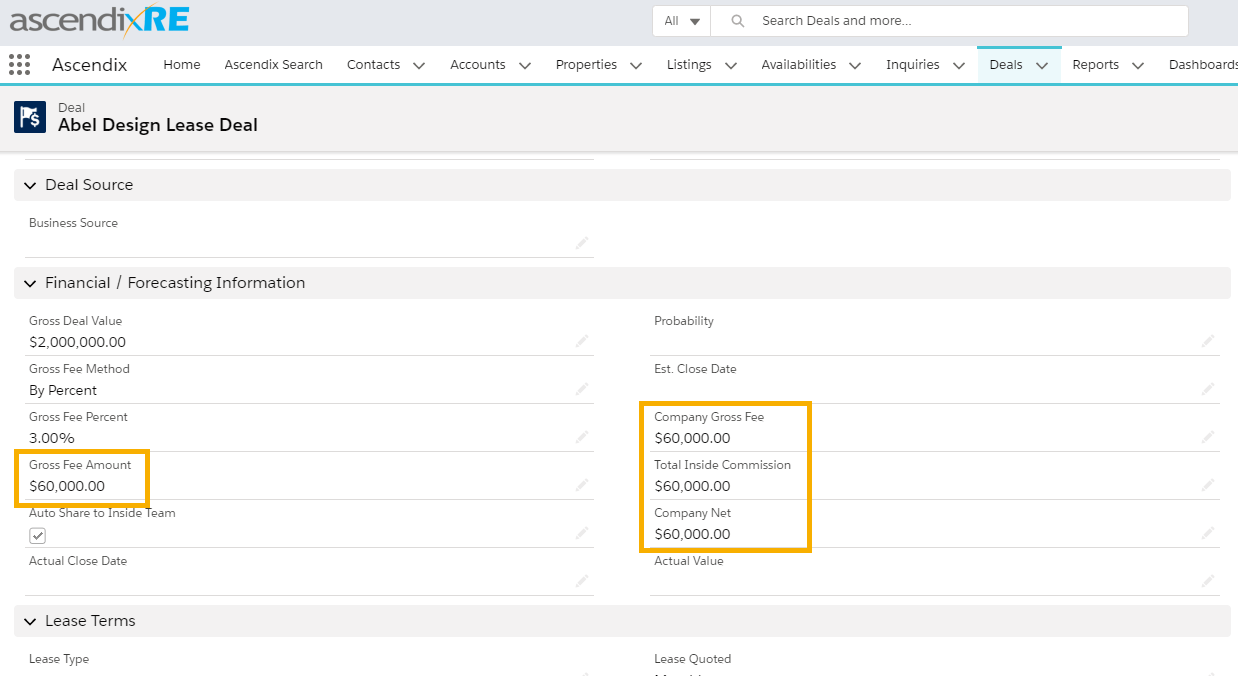
Calculate Company Gross Fee, Total Inside Commission and Company Net
This result is also shown as “Total Inside Commission” formula fields on all commission records tied to this Deal.
Watch a full video on how to track and calculate commercial real estate commissions below:
The “Amount” and “Net Commission” are calculated based on the commission type:
Amount = Gross Fee Amount * Commission Fee Percent
Net Commission = Gross Fee Amount * Commission Fee Percent
Fee Amount = Total Inside Commission * Fee Percent
Net Commission = Fee Amount – Fee Amount * House – Direct Expenses – Other Expenses
Amount = Company Gross Fee * Fee Percent
Net Commission = Company Gross Fee * Fee Percent
Amount = Company Gross Fee * Fee Percent
The Commission Calculations are rigid and can’t be changed through configuration.
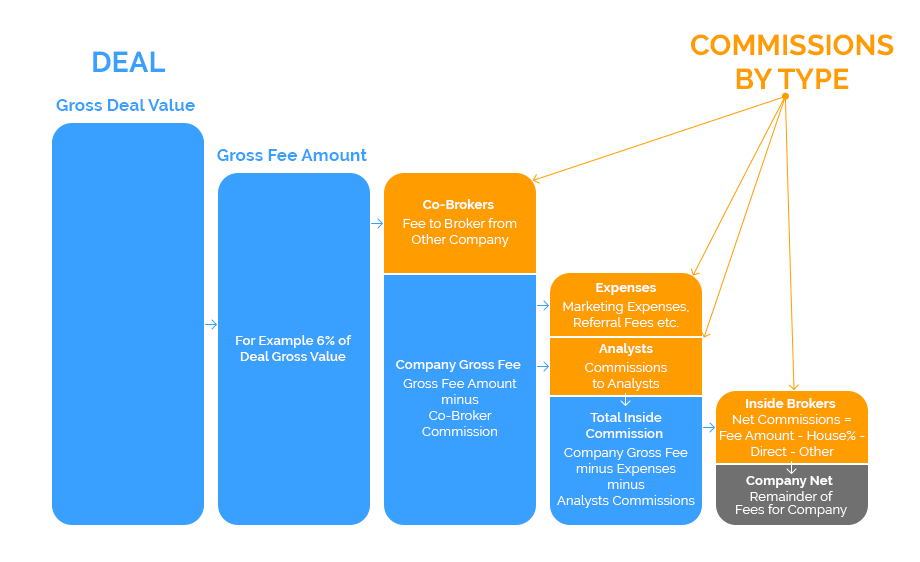
Real Estate Commissions by Type
Let’s see how to track real estate commissions by following the steps in the simple example below.
*Note: In the leasing space the Gross Deal Value would be the Total Rent over the period of years and in the sale space it would be the Sale Price of the property.
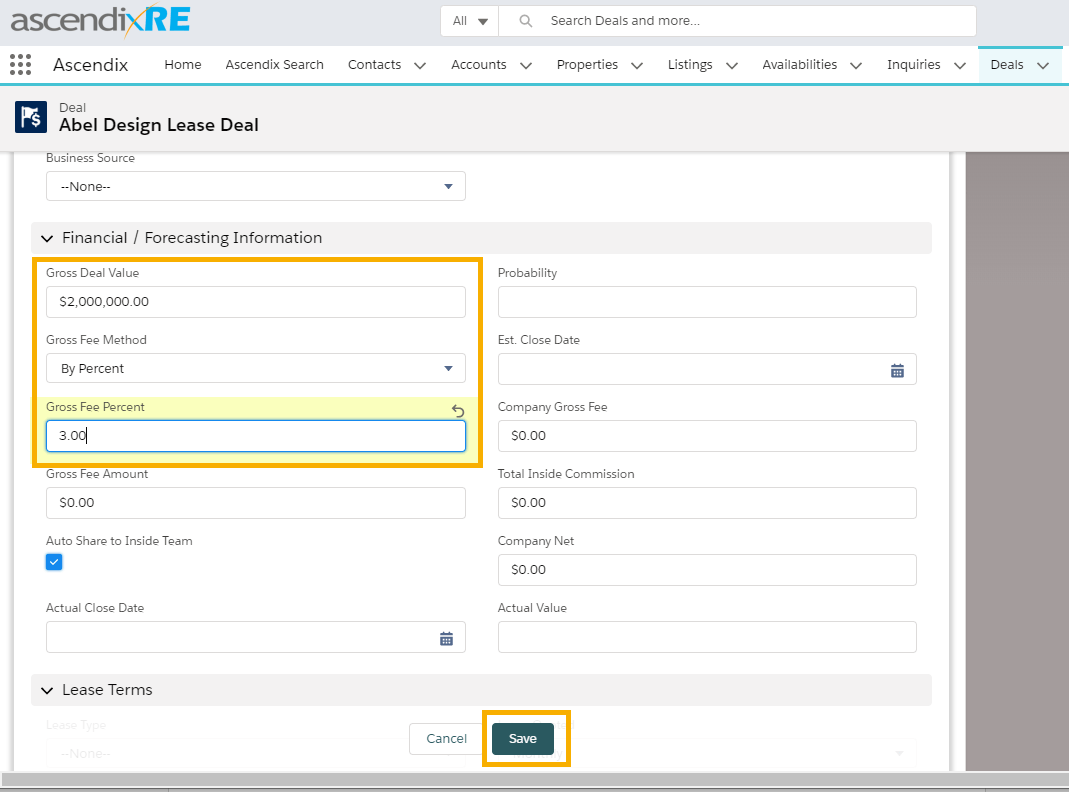
Enter Financial and Forecasting Information
In this example below $2, 000, 000 is this entire Gross Deal Value and the commission or Gross Fee Percent is 3%.
The estimated Gross Fee Amount is $60, 000 that equals to 3% out of $2, 000, 000.
Calculate Company Gross Fee, Total Inside Commission and Company Net
You can see that the sum in Gross Fee Amount is duplicated in Company Gross Fee, Total Inside Commission and Company Net.
The reason is we have not reduced this $60, 000 any further because we haven’t started tracking Brokers’ Commission Split and House Split or Co-broker’s commissions etc.
To learn how to enter Inside Broker’s commission, read the next step.
Create New Commission
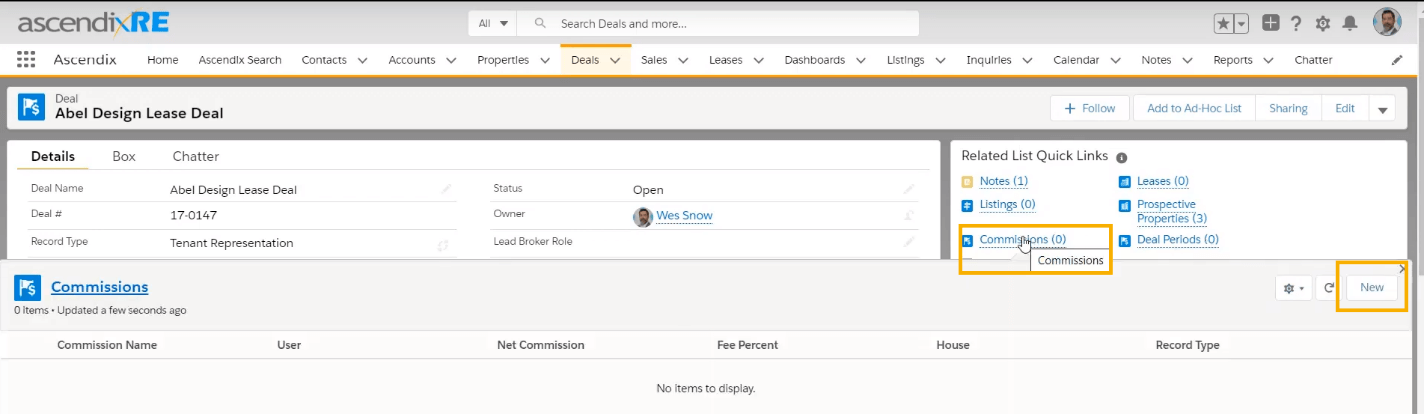
To add Commissions information, do the following:
1. Click on “Commissions”,
2. Click New,
3. Choose Commission Type: Inside Broker,
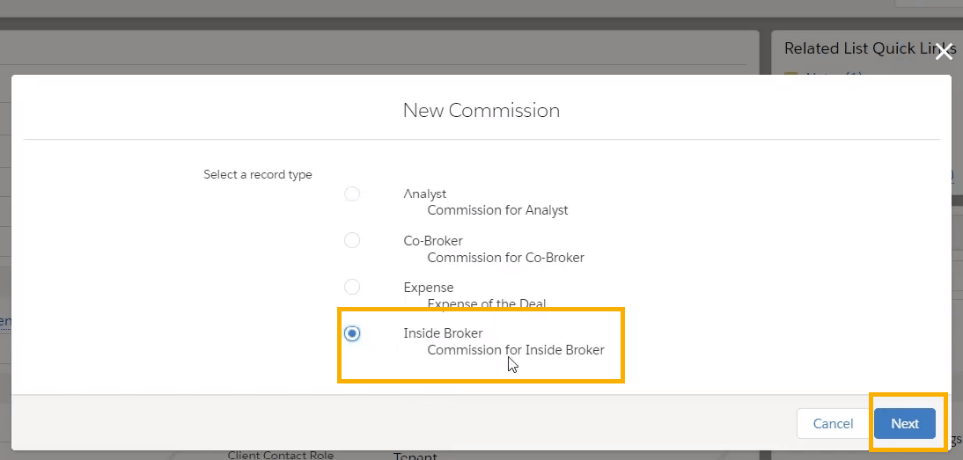
Choose Inside Broker Commission Type
4. Click Next,
5. Add the user who is receiving a commission,
6. Select User from the list,
7. Select Fee Method,
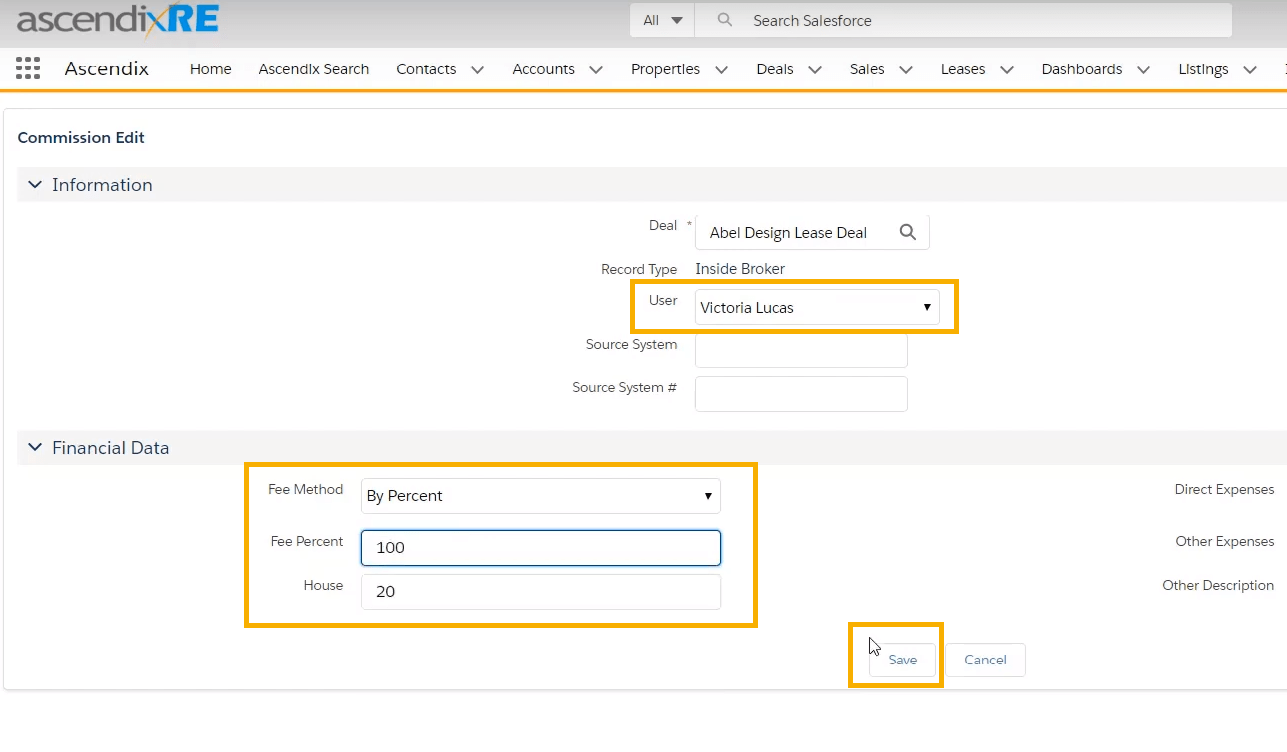
Enter Inside Broker Commission Information
For example, Inside Broker was splitting this deal 80/20 with the House where she was getting 80% and the House was getting 20%.
Then you’d put in 20 for House but for a Fee Percent you’re going to be putting in not 80 but a 100 because Victoria is getting 100% of that 80% balance.
Another case if Inside Broker were splitting this deal with another Inside Broker let’s say 50\50. Then this Fee Percent would not be a 100 it would be 50. We’d need to create another Commission Record for the second person that was splitting that deal with her.
In this example we put a 100 for Fee Percent and Save. It will bring us directly not to the Deal record but to the Commission record.
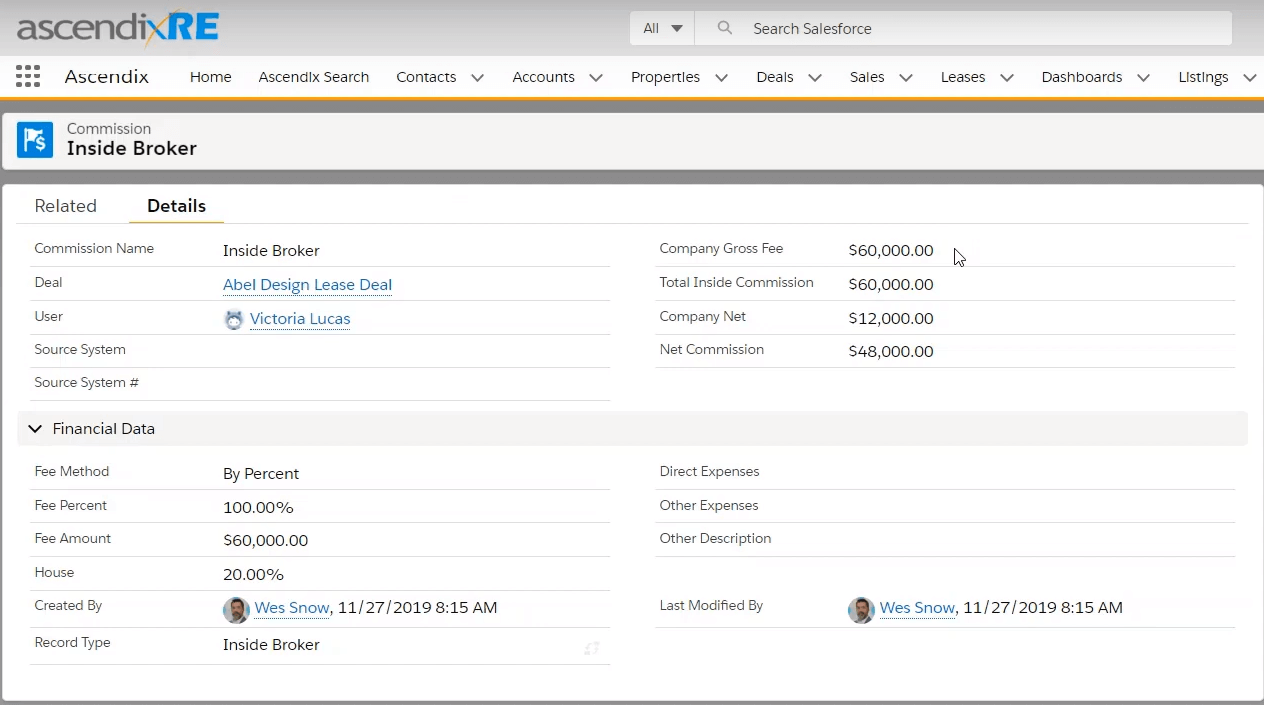
Inside Broker’s Commission Record
If we look at the numbers, we started off with $60, 000 that was the 3% of the $2, 000 000. Now that 80/20 split has reflected on the Company Net (income of the company where Inside Broker works) that resulted in 12 000$ because Inside Broker is getting 48 000$ (Net Commission) and 20% ($ 12,000) goes in House.
It is one of the simplest scenarios of Commission Splits of the Deal. Below are more complicated examples of real estate commission calculators.
See how AscendixRE helps commercial real estate teams track deals, splits, and payouts more efficiently.
To this real estate deal scenario into the reality, we have to fill in financial information of the deal, analyst’s and co-broker’s fees and expenses amount.
As a result, you get $60, 000 Gross Fee Amount, Company Gross Fee, Total Inside Commission, and Company Net.
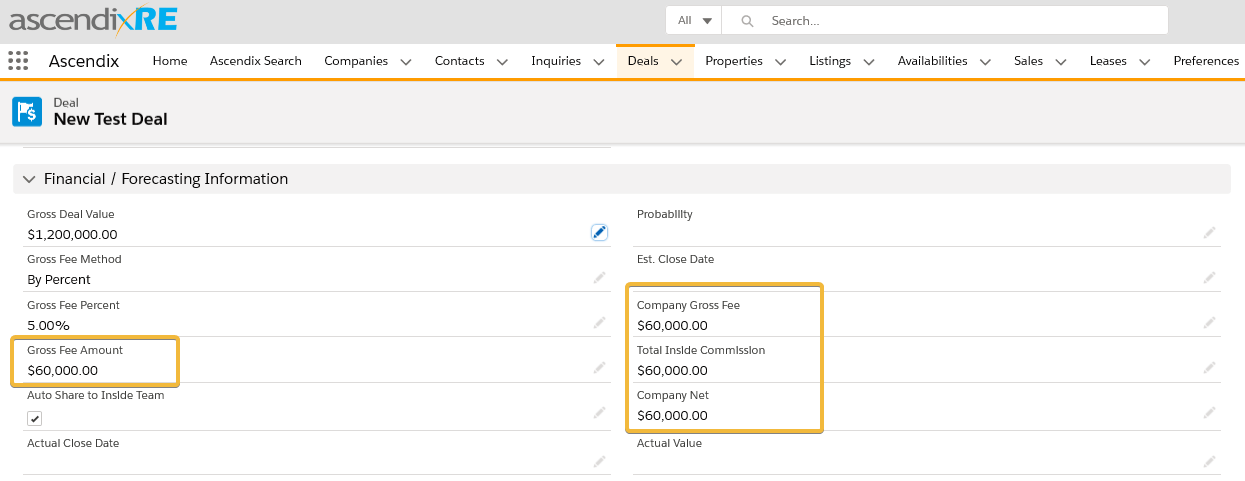
Company Gross Fee, Total Inside Commission, and Company Net of a Deal
To enter commissions information, go to Related List Quick Links widget and click “Commissions” link. Then do the following:
1. Click New,
2. Choose Commission Type: Co-Broker,
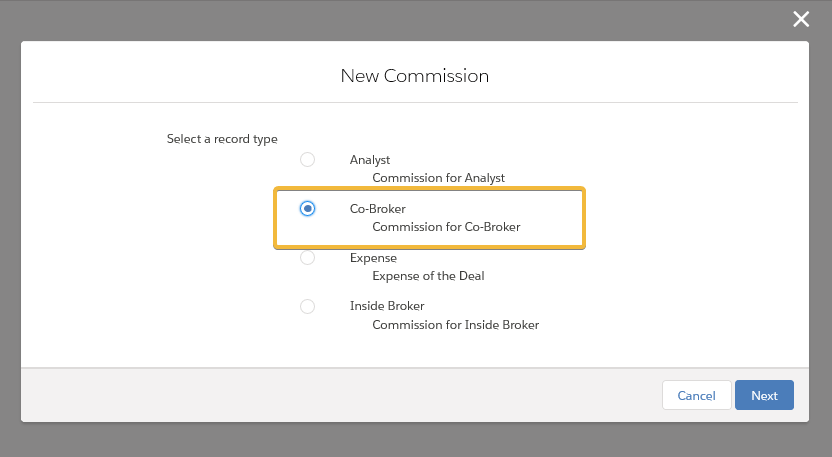
Choose Co-Broker Real Estate Commissions Type
3. Click Next,
4. Find an Account or a Contact to Add,
5. Select Fee Method “By Percent”,
6. Enter Fee Percent – 25,
7. Click Save.
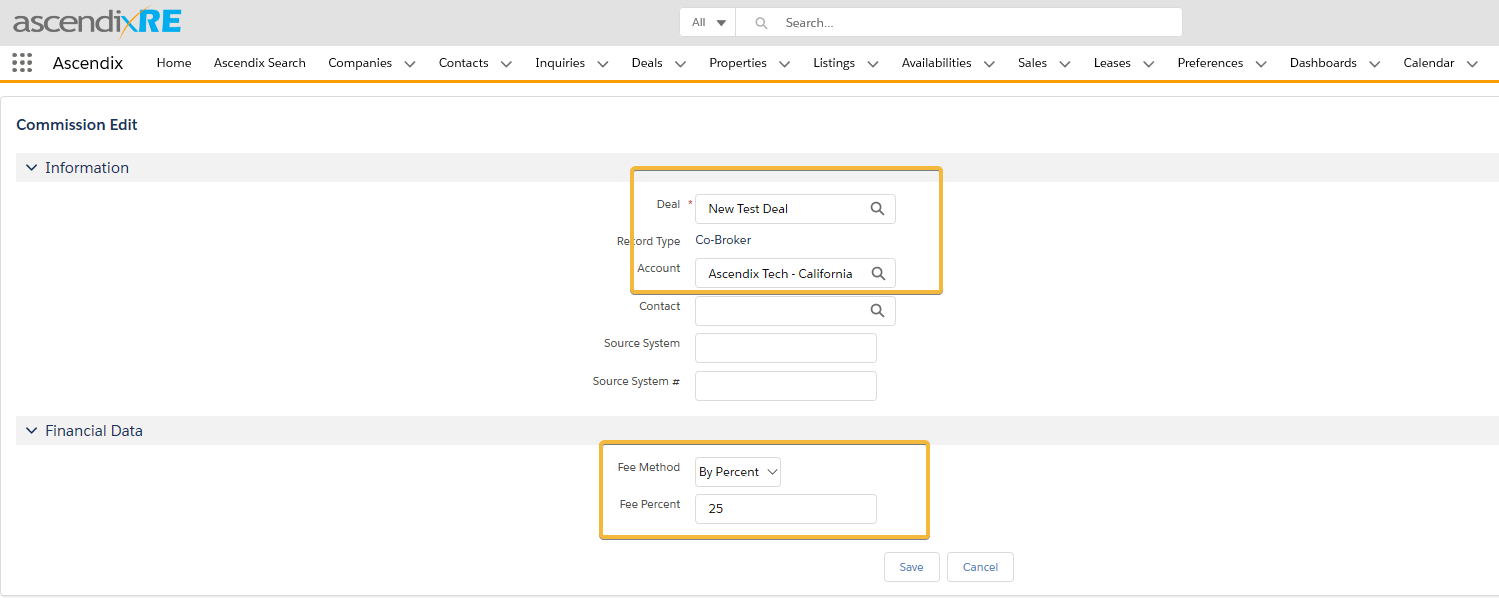
Select Fee Method and Fee Percent
1. Click New,
2. Choose Commission Type: Analyst,
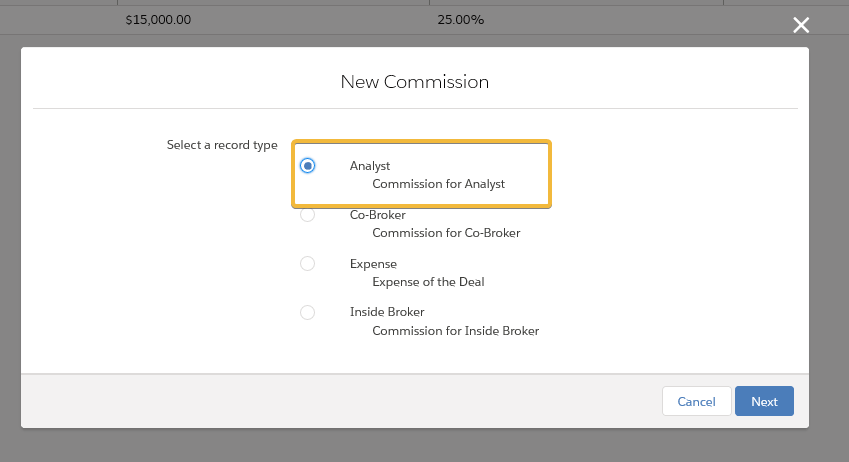
Choose Analyst Real Estate Commission Type
3. Click Next,
4. Find an Account or a Contact to Add,
5. Select Fee Method “By Amount”,
6. Enter Fee Amount – 9, 900,
7. Click Save.
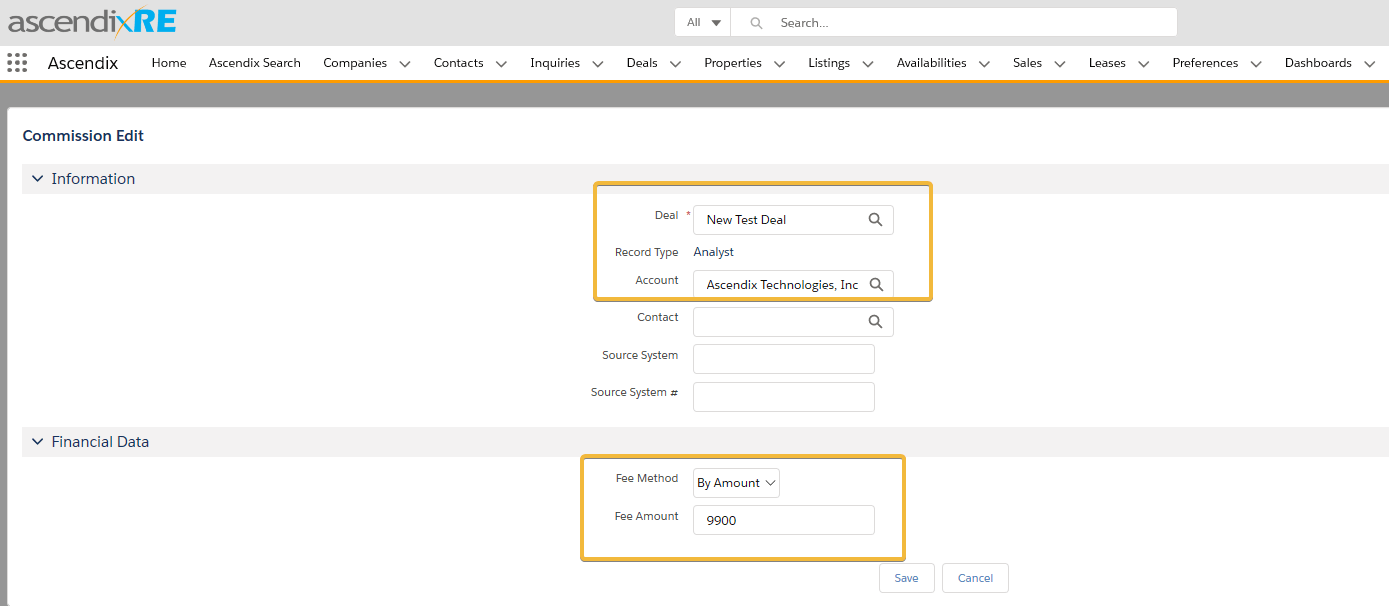
Enter Fee Method “By Amount” and Fee Amount
1. Click New,
2. Choose Commission Type: Expense,
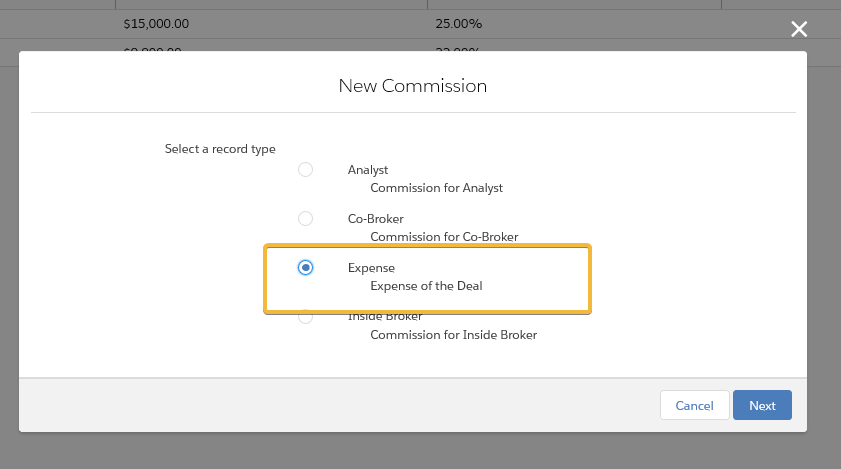
Choose Expense Real Estate Commission Type
3. Click Next,
4. Select Fee Method “By Amount”,
5. Enter Fee Amount – 1, 000,
6. Click Save.
Enter Fee Method “By Amount” and Fee Amount
And here is how the numbers have changed considering Co-Broker’s and Analyst’s fees together with Expenses:
Company Gross Fee, Total Inside Commission, and Company Net of a Deal
The original amount of Company Gross Fee, Total Inside Commission, and Company Net was $ 60,000. After all the real estate commission calculations Company Gross Fee is $ 45,000, Total Inside Commission − $34,100, and Company Net − $34, 100. Below is more complicated real estate commissions calculator scenario.
In this example, you may have one more multiple commission calculation scenario inside a particular deal. The beginning is the same, to start the calculations you need to enter financial information of the deal, then add Inside Brokers’ and Analysts’ fees.
Gross Fee Amount, Company Gross Fee, Total Inside Commission, and Company Net equals to $60, 000.
We enter deal commissions for 4 Inside Brokers:
1st Inside Broker gets 25% Split Fee, 10 % goes in House,
2nd Inside Broker gets 25% Split Fee, 15 % goes in House,
3rd Inside Broker gets 25% Split Fee, 10 % goes in House,
4th Inside Broker gets 25% Split Fee, 25 % goes in House, 1,000 is Direct Expenses.
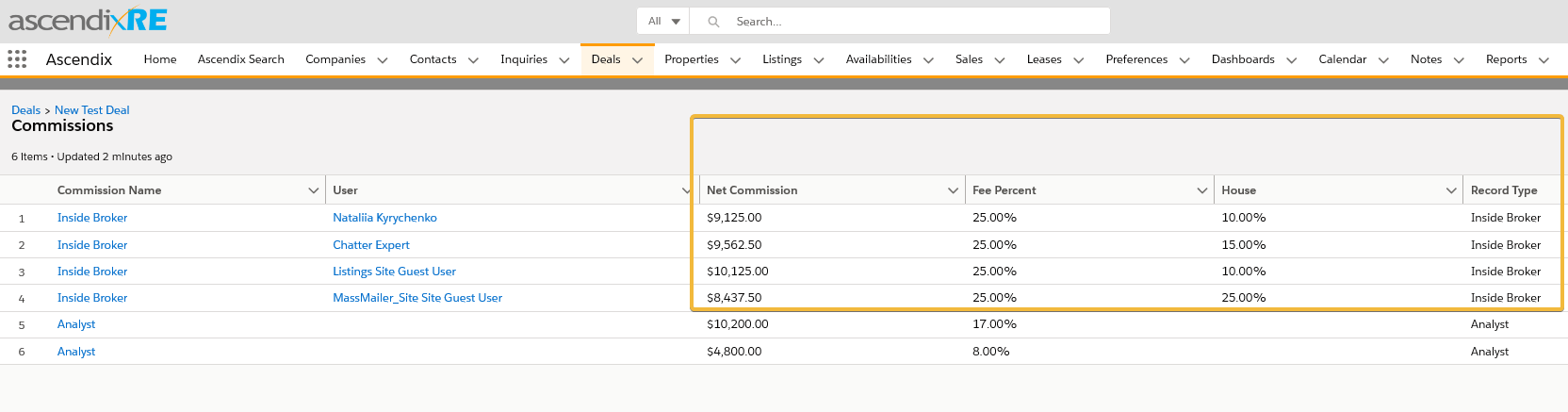
Inside Brokers’ Real Estate Commissions Calculator
Step#3 – Enter Analysts’ Commissions
Analysts’ real estate commissions are the following
1st Analyst receives 17% fees,
2nd Analyst receives 8% fees.
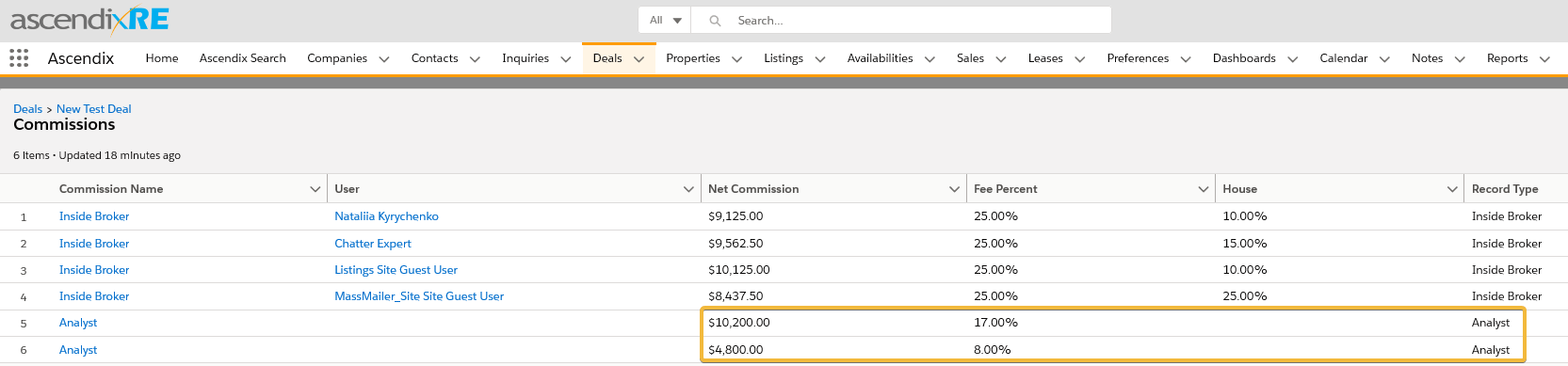
Analysts’ Real Estate Commissions Calculator
Let’s check how the numbers have changed after all the commissions calculations.
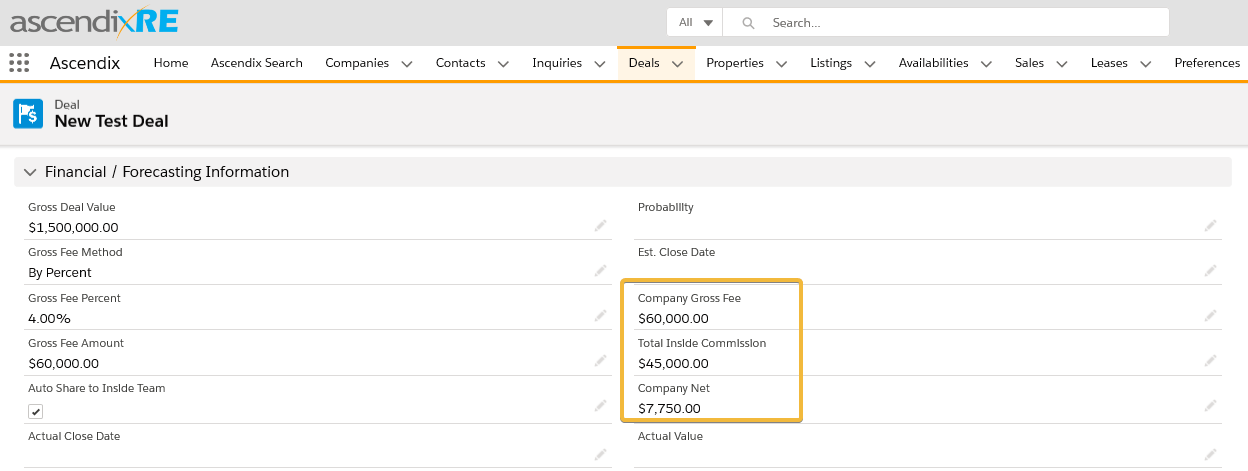
Final Deal Commissions Calculations
Company Gross Fee stays the same $60, 000 as before, Total Inside Commission are now $45, 000 and Company Net is $7, 750.
*Note: All the real estate commission calculations can be edited as long as the deal is still open. Another point to add is the Commissions are not really intended for invoice purposes. They are just meant for a tracking mechanism.
Further, you may use Commissions for reporting as a part of Company Gross Fee, Total Inside Commission, and Company Net.
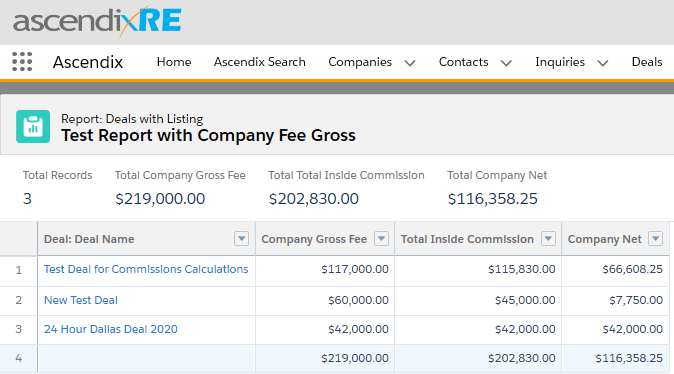
Sample of Company Fee Gross Report
And then this report can be placed on the Dashboard and re-used any time you need this report.
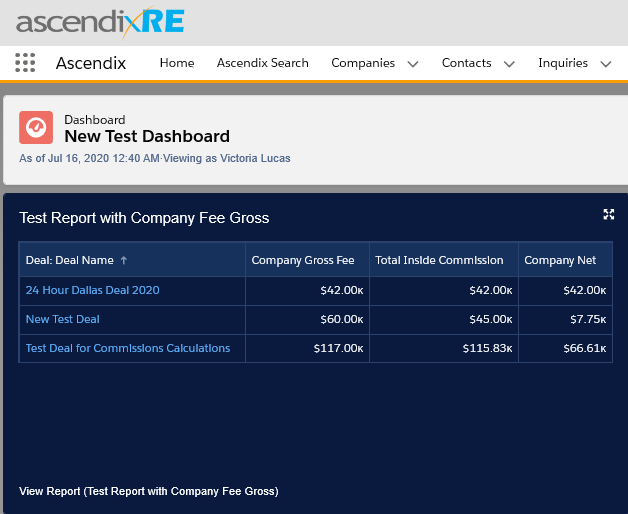
Sample Company Gross Report on the Dashboard
You just walked through three of these calculations by hand. In AscendixRE, the same math runs automatically as part of the deal record:
If you’re calculating commissions by hand today, at some point the question shifts from “how do I do this math” to “what should I use instead.” A few things worth checking on any platform:
For a full side-by-side comparison of commission tracking platforms, see Best Commercial Real Estate Commission Tracking Software in 2026.
AscendixRE approaches commission tracking as part of a broader CRE workflow, not as an isolated back-office task.
Because it is built for commercial real estate and delivered on Salesforce, teams can manage deal data, broker activity, reporting, and commission tracking in one connected environment. That matters because commission tracking works best when it is tied to the same records where the deal was sourced, updated, and closed.
Instead of exporting deal data into a separate system, brokerages can keep calculations, participant roles, and reporting tied to the same CRM records. In practice, that means one system of record: commission numbers and CRM data are read the same way by everyone in the brokerage, instead of being reconciled by hand across tools.
The Gross Fee Amount is calculated from the deal (by percentage, lease-term structure, or dollar-per-square-foot), then co-broker fees, referral fees, and other deductions are subtracted to determine the Company Gross Fee. What remains is divided according to each participant’s commission plan: Inside Broker splits, Analyst fees, and the house split.
Co-brokers are paid first, followed by expenses, then analysts, with Inside Brokers paid last from the remaining Gross Fee Amount.
Standalone commission tracking software calculates and records payouts but keeps that data separate from deal and contact records. A CRM with commission tracking built in, like AscendixRE, ties commission calculations directly to the deal record, so brokers, finance, and leadership are working from the same data without exporting or re-entering it elsewhere.
Before. Co-broker and referral fees are deducted first, along with other expenses, to determine the Company Gross Fee. The house split is then calculated from what remains, not from the original Gross Fee Amount.
Anzhelika is a seasoned B2B content marketing strategist with extensive experience in elevating corporate profiles through compelling content. At Ascendix, she offers a wealth of knowledge in Salesforce consulting, providing valuable tips, tricks, and comprehensive guides. Additionally, Anzhelika stays at the forefront of the industry, delivering expert analysis on the latest Salesforce tools and emerging technology trends.
 (34 votes, average: 5.00 out of 5)
 Loading...
Subscribe for practical insights on CRE commission tracking, brokerage operations, and smarter ways to manage deals, splits, and payouts.
Wonderful blog post about commissions in real estate! As an individual navigating the intricacies of this sector, the comprehensive analysis proved to be immensely beneficial. With its superb real estate commission tracking software, Flow Commission guarantees precise payouts and streamlines calculations. I heartily suggest this resource to anyone working in the field!