See AscendixRE CRM in Action
Book a demo to explore how AscendixRE CRM powers up CRE business with AI.


A commercial real estate broker’s day is deal calls, site tours, and client follow-ups. It is also 40 minutes of copying email data into a CRM that is already three days behind. If your database is outdated, your AI is useless.
Most platforms draft emails and suggest follow-ups. You still do all the data work. Agentic AI actually does it: parses emails into CRM records, logs call notes by voice, queries your pipeline from inside ChatGPT.
This comparison covers 10 real estate CRMs with AI across residential, commercial, and investment sectors. Use the quick answer block to find your starting point.
| If you are | Best starting point | Why |
|---|---|---|
| A CRE brokerage that wants AI to handle admin and CRM data | AscendixRE with AI Suite | Only CRM that handles both data capture and retrieval with AI; connects to ChatGPT and Claude |
| A CRE brokerage evaluating a unified deal workflow platform | Buildout CRM | End-to-end deal engine built for CRE; strong on pipeline-to-marketing continuity |
| A high-volume residential team needing lead automation | Follow Up Boss or Lofty | Strong AI follow-up and lead scoring; wide integration ecosystem |
| A residential brokerage focused on relationship intelligence | MoxiWorks RISE | Proactive AI that surfaces who to call and when; built for sphere management |
| A growing agency needing CRM plus marketing in one platform | HubSpot Smart CRM | Broad capability; not real-estate-specific but scales well |
| A real estate investor or wholesaler | REsimpli | Purpose-built for investment workflows; not suitable for brokerage or CRE teams |
Evaluating an AI-powered CRM for real estate requires looking past the marketing hype. Every software vendor claims to have AI in 2026. Very few have built tools that fundamentally change how a broker works. We used five strict criteria to separate surface-level AI from actual workflow automation.
| CRM | Segment | Standout AI capability | AI type | Starting price |
|---|---|---|---|---|
| AscendixRE + AI Suite | Commercial RE | Email-to-CRM parsing, voice logging, ChatGPT/Claude integration | Agentic | $79/user/mo + AI Suite from $39/org/mo |
| Buildout CRM | Commercial RE | End-to-end deal workflow; AI executes repeatable brokerage tasks | Agentic / Hybrid | ~$120/user/mo |
| Salesforce + Agentforce | Enterprise | Autonomous agents across deal pipeline, email, and reporting | Agentic | Varies; requires implementation |
| Follow Up Boss | Residential | AI-powered lead scoring and Smart Messages; Zillow integration | Generative | $69/user/mo |
| kvCORE | Residential | Alex AI handles inbound leads 24/7; behavioral lead scoring | Hybrid | ~$500/mo team minimum |
| Lofty | Residential | Multi-agent automation: sales, social, listing agents | Agentic | Contact for pricing |
| MoxiWorks RISE | Residential | Top 5 Contacts: daily AI-driven relationship prioritization | Generative | Starter and Pro tiers |
| HubSpot Smart CRM | General | Breeze AI summarizes records; drafts property descriptions | Generative | Free tier; paid from $20/mo |
| REsimpli | Investors | AI call answering and lead qualification for distressed acquisitions | Hybrid | Contact for pricing |
| Lone Wolf Relationships | Enterprise Resi | AI email marketing; connects to full Lone Wolf transaction ecosystem | Generative | Contact for pricing |
AscendixRE is a purpose-built ai crm commercial real estate solution. The AscendixRE AI Suite attacks data entry friction directly.
Strengths:
Limitations:
Pricing: AscendixRE from $79/user/month (includes Salesforce license). AI Suite from $39/org/month, priced per organization rather than per user. For map-based prospecting and radius search, see Ascendix Search. Document generation is handled by Composer AI.
Book a demo to explore how AscendixRE CRM powers up CRE business with AI.
Buildout launched its CRM component in March 2026 as the final piece of a unified CRE deal engine. Prospecting connects to the CRM, the CRM connects to listings, and listings connect to marketing and deal tracking across a single data layer. The result is fewer manual handoffs between marketing and transaction management.
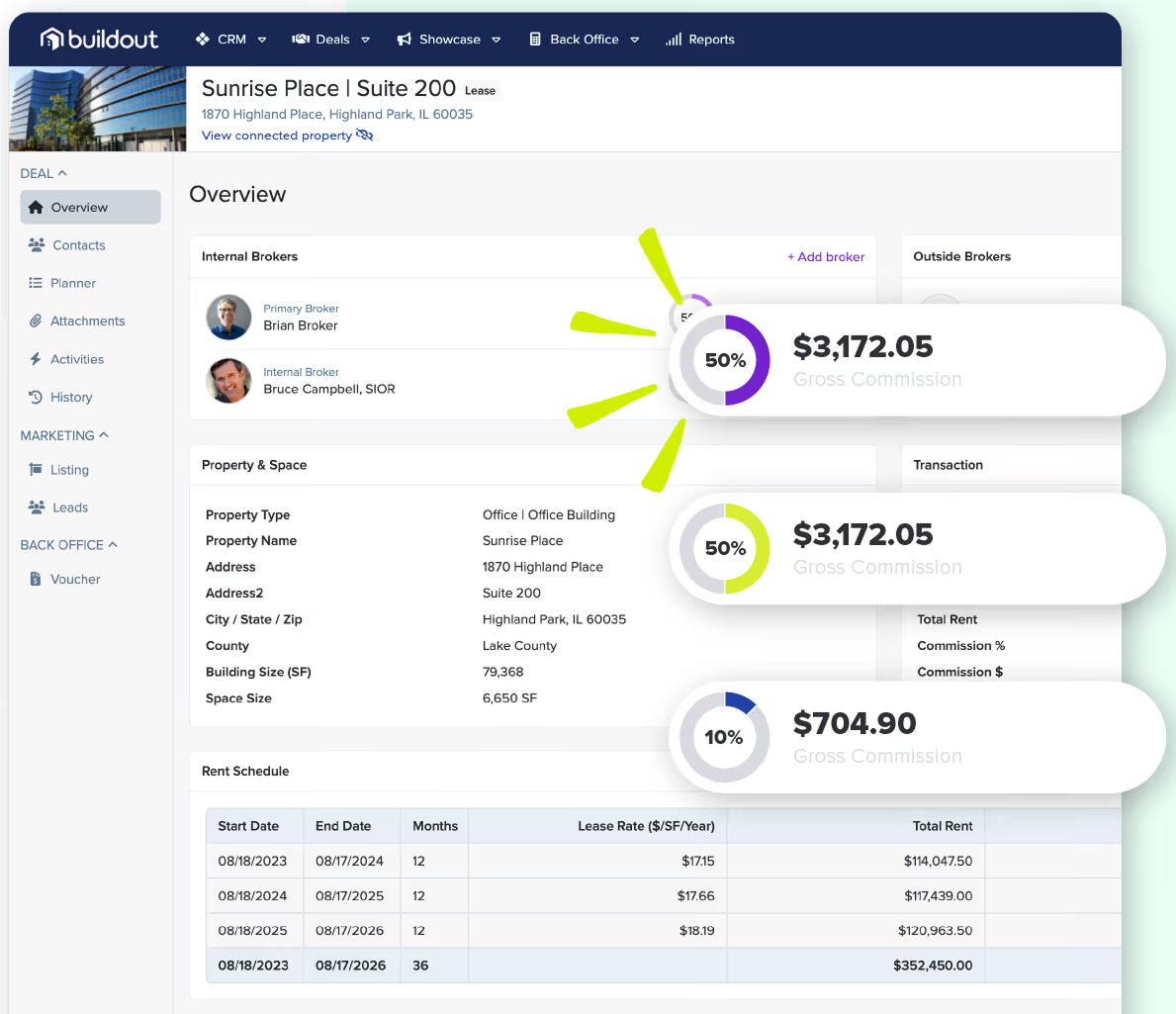
Buildout Manage & Close | Source: Buildout
Pricing: Approximately $120/user/month. Contact Buildout for current packaging and implementation options.
Salesforce combined with Agentforce delivers enterprise-grade autonomous capabilities. This is not just a real estate CRM with AI layered on top. Agentforce allows you to deploy custom AI agents that execute specific roles. You can build an SDR Agent to qualify inbound leads or a Service Agent to handle tenant maintenance requests.
Pricing varies significantly based on cloud configurations, user counts, and Agentforce consumption credits. It requires formal scoping and a dedicated implementation budget.
“ Real estate firms often have unique workflows. But don't reinvent the wheel. Start with Agentforce's standard actions, then layer in custom components. Prioritize one high-impact workflow rather than attempting full-scale implementation.
Even by customizing just three core workflows you can save up to 40 hours weekly. We typically recommend beginning with deal screening automation as it provides immediate ROI and team buy-in. ”
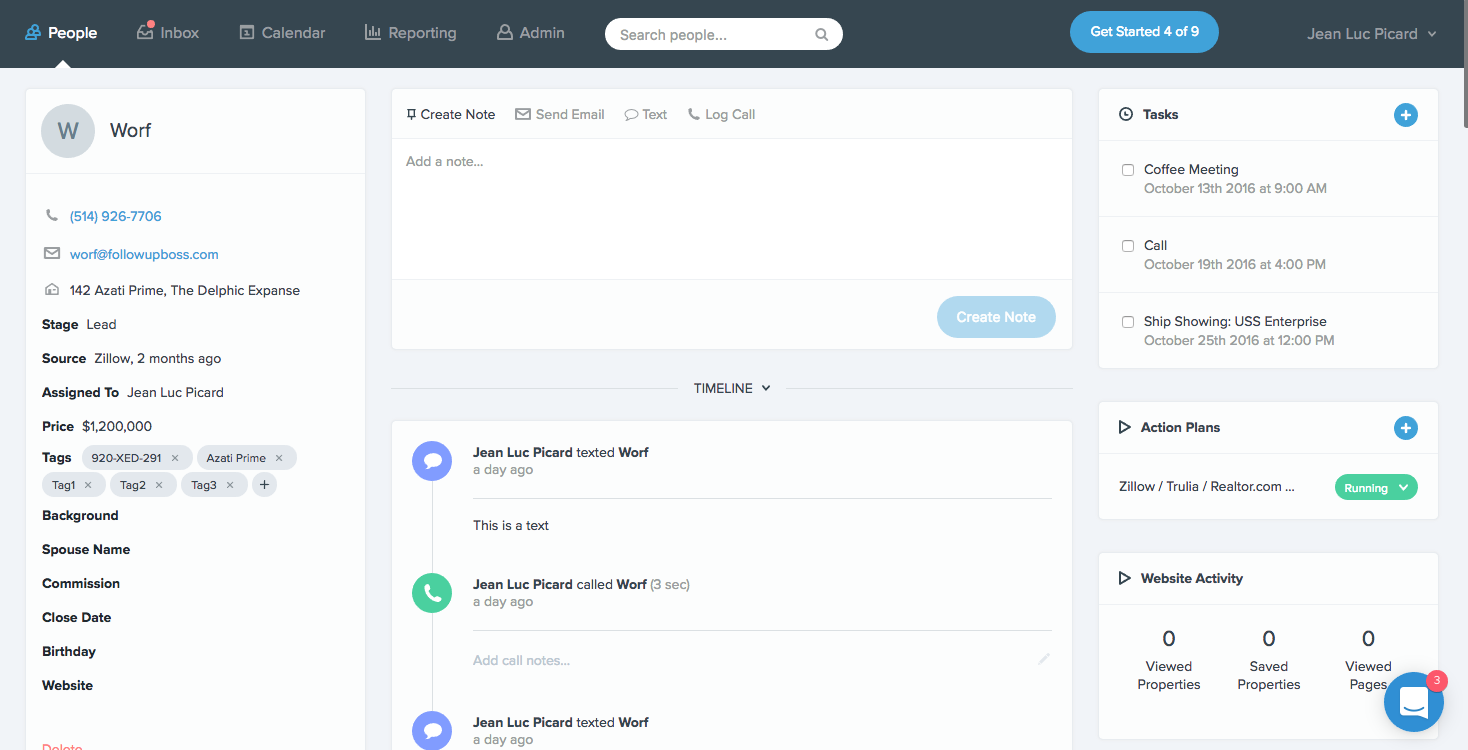
Follow Up Boss (FUB) is widely considered one of the best AI CRM for real estate agents in the residential sector. Its primary strength lies in managing high-volume lead flow. The platform uses AI-powered lead scoring to tell residential agents exactly who to call first based on website behavior and engagement.
Pricing starts at $69/user/month. Advanced features and dialer integrations require higher-tier plans.
Learn how agentic AI keeps your CRM accurate without extra work from your team.
kvCORE is a comprehensive residential platform that combines IDX websites with an AI-powered real estate CRM. Its standout feature is Alex AI, an intelligent virtual assistant. Alex AI handles inbound conversations 24/7 via text and chat. It qualifies leads, answers basic property questions, and books appointments directly onto the agent’s calendar.
kvCORE is typically sold at the brokerage or team level. Pricing generally starts around $500 per month for team minimums, though enterprise pricing varies based on agent count.
Formerly known as Chime, Lofty has rebranded with a heavy focus on multi-agent automation. It stands out in the residential space by pushing beyond basic generative text. Lofty deploys specific AI personas to handle different tasks.
Lofty requires a custom quote based on the specific AI agents deployed and user count. Contact Lofty directly for pricing details.
“ An important lesson for any enterprise, commercial real estate, or otherwise, that's thinking, "How do I implement AI?" is to change the approach to: "What can I do to impact my business the most now? Are there some pain points that I can address right now?"
Don't go after fads. You have to understand your business. Keep in mind that you can't try to do everything at once. Pick one, two, or three pain points that need solving, and look to see if AI is ready to take over. That will be the recipe for a successful introduction of AI in your organization. ”
MoxiWorks takes a different approach to real estate CRM AI features. Instead of focusing exclusively on internet lead conversion, MoxiWorks RISE optimizes sphere-of-influence management.
Strengths:
Limitations:
MoxiWorks offers Starter and Pro tiers. Pricing is usually negotiated at the brokerage level. Contact MoxiWorks for specific per-seat costs.
“ The real opportunity with AI isn't adding more features. It's improving how work actually gets done. We focus on understanding agent workflows end to end, then using AI to turn existing data into clear, actionable next steps. When you connect intelligence, context, and execution in one system, you simplify the work and make agents more effective day to day. ”
HubSpot is a global leader in marketing automation. Its Smart CRM features Breeze AI, a highly capable generative engine. Breeze AI automatically summarizes long email threads, drafts personalized outreach, and generates marketing copy for landing pages.
Strengths:

Limitations:
HubSpot offers a free tier. Professional plan starts at $50/seat/month. Enterprise starts at $75/seat/month.
REsimpli is purpose-built for real estate investors, not brokers. The AI handles inbound calls from motivated sellers, qualifying leads through structured conversations and routing high-intent contacts to acquisition managers. Lead scoring identifies distressed situations by behavioral and data signals. The platform covers skip tracing, direct mail, and disposition tracking alongside the CRM, making it a full acquisition stack for investors.
The hybrid classification reflects AI that handles inbound qualification autonomously (agentic) while keeping outbound communication and offer drafting in the generative category. For wholesale and fix-and-flip operations running high-volume outreach, this is one of the few platforms built specifically for that workflow.
As for limitations, this AI-powered real estate CRM is not designed for brokerage or CRE team workflows. Seller-acquisition vocabulary and deal structures will not transfer to commercial real estate or residential brokerage operations.
To learn more about pricing and plans, we recommend contacting REsimpli.
Lone Wolf Relationships is the CRM component of the Lone Wolf real estate software ecosystem. Its primary strength is native connectivity to tools like zipForm and Back Office, with data flowing directly from the CRM into transaction management and accounting.
Strengths:
Limitations:
Lone Wolf Relationships requires custom enterprise quoting. Pricing depends on your existing Lone Wolf software footprint and agent count.
“ We studied how agents manage their relationships and designed a system that enhances their natural workflow instead of forcing them to change how they work. Relationships gives agents the tools they need to build lasting connections without the complexity that comes with traditional CRMs. ”
Not every AI CRM is solving the same problem. Before evaluating platforms, it helps to know which capabilities actually move the needle for your deal type and team size.
The most important question when selecting an AI CRM for real estate is simple: what does the AI actually do?
Most platforms on the market write emails. That saves a broker two minutes. It does not solve the real problem, which is that brokers do not update their CRM, so the data is always behind, and any AI querying it gets stale answers.
To fix that, you need agentic AI. Generative AI changes what the broker sends. Agentic AI changes what is in the CRM. Most real estate CRM AI features you see advertised today are generative. That distinction matters more than any feature list.
Why generic CRMs fail for CRE workflows:
For CRE teams, the best AI CRM for real estate agents and brokers is one that handles data capture natively and understands CRE terminology without configuration. For residential teams, prioritize speed and volume automation. The AI-powered real estate CRM you choose should understand your asset class, not just real estate in general.
The right AI CRM for real estate depends on what problem you are actually trying to solve.
The key distinction: generative AI makes brokers better communicators. Agentic AI makes the CRM more accurate. Most teams need both, but agentic AI has higher leverage because the data it captures makes every other AI feature more reliable.
For CRE teams specifically, AscendixRE AI Suite addresses both sides of the data problem:
Ready to see how agentic AI can eliminate your administrative bottlenecks and keep your deal pipeline perfectly accurate? Reach out and we will set up a call.
A regular CRM stores contact and deal records but relies on the broker to update them manually. An AI CRM automates data entry by parsing inbound emails into records, logging calls by voice, or scoring leads by behavior, so the CRM stays current without extra work from the broker. The most advanced AI CRMs also let brokers query their data from external tools like ChatGPT, not just from inside the CRM interface itself.
AscendixRE with AI Suite is the only CRM on this list with a native MCP-based connection to ChatGPT and Claude. Brokers can ask questions about their CRE pipeline in plain English from inside ChatGPT or Claude and get answers drawn directly from their live AscendixRE records, without opening the CRM.
Email parsing automatically extracts structured data from inbound emails and converts it into CRM records. In a CRE context, this means forwarding a LoopNet inquiry, an LOI, or a new availability to a designated address and having the contact details, lease terms, and property information appear as a draft record ready for broker review. AscendixRE Harvest does this natively, and nothing saves without broker approval.
Most AI CRMs on the market are designed for residential real estate and lack the data models needed for CRE workflows: lease structures, stacking plans, rent rolls, NNN terms, and multi-party deal tracking. AscendixRE and Buildout CRM are the two purpose-built options for commercial real estate in 2026. AscendixRE also includes AI tools that understand CRE terminology natively, without requiring configuration.
Pricing varies significantly by segment and feature depth. Residential AI CRMs range from $20/user/month (HubSpot) to $500 or more per month for team plans (kvCORE). AscendixRE starts at $79/user/month including a Salesforce license, with the AI Suite available as a paid add-on from $39/org/month, priced per organization rather than per user. Enterprise platforms like Salesforce with Agentforce require scoping for accurate pricing.
The right AI CRM for real estate depends on what problem you are actually trying to solve.
For residential teams, the priority is speed: lead scoring, automated follow-up, and AI that handles inbound conversations without adding headcount.
For CRE brokerages, the problem is different. The CRM falls behind because brokers do not update it, not because they lack features. Any AI that does not fix the data capture problem is solving the wrong thing.
The key distinction: generative AI makes brokers better communicators. Agentic AI makes the CRM more accurate. Most teams need both, but agentic AI has higher leverage because the data it captures makes every other AI feature more reliable.
For CRE teams specifically, AscendixRE with AI Suite addresses both sides of the data problem:
Harvest gets information in without manual entry
Connector gets it back out through the AI tools brokers already use
That combination, paired with CRE-native data models and an enterprise-grade Salesforce foundation, means teams are not adapting a generic tool to fit their workflows. It was built for these workflows from the start.
If you want to see how AI Suite fits your team’s specific setup, our team is happy to walk you through it. Reach out and we will set up a call.
Darina creates compelling content about Salesforce products, Ascendix services, and CRM best practices. Her articles provide valuable tips and insights and help readers stay abreast of the recent trends in the commercial real estate industry.
 (64 votes, average: 4.98 out of 5)
 Loading...