Jason Berry and his team at Slatt Capital have been early adopters of technology and use it not only for managing the data, but to make smarter and faster business decisions. And we’ll talk about how innovation is reshaping capital markets and the challenges of capturing meaningful data, and what the rise of AI means for companies like Slat Capital moving forward.
Key topics covered:
- 02:45 – Capital markets technology challenges
- 04:13 – Good, Fast, Cheap – what to choose when it comes to AI in Capital Markets?
- 05:19 – If AI is not taking jobs, what does it do?
- 05:53 – Ascendix Technologies’ mission on democratizing data
- 06:40 – AI Agents – the future of AI in capital markets
- 08:58 – The importance of digital experience
- 09:43 – AI adoption in progress
- 10:21 – Why good specialised solutions are so expensive
- 12:30 – Tips for effective capital markets technology adoption
- 14:46 – So, if not AI, what is taking all the jobs?
Data Capture Challenges
Rocket Mortgage encouraged AI adoption among sectors adjacent to lending by launching its AI platform and sharing the results:
- Currently, Rocket Logic automatically identifies nearly 70% of the more than 1.5 million documents received monthly, resulting in a savings of more than 5,000 hours of manual work for underwriters in February 2024 alone.
- Of the 4.3 million data points extracted from documents, including W-2s and bank statements in February, nearly 90% were automatically processed, saving an additional 4,000 hours of manual work for team members.
“ In the old world, pre-AI, getting the data out of a document and putting it into, let's say, an Excel spreadsheet that was human-driven, right? And it took a lot of either expertise or training, and it worked fine. Now you can use AI, but you still need to review it. Also, speed makes a difference. ”
Jason Berry, COO of Slatt Capital
“ What we've realized in the problem that we're eventually going to solve is democratizing all of that really rich data that resides inside the inbox of today's knowledge worker. Term sheets, quotes, broker's opinion of value, offering memorandums, lease and sale comps, all of which are in the cloud file storage or inbox, never having been liberated, so that the entire organization can benefit from that.
AI is perfect for that. ”
Wes , CEO of Ascendix Technologies
Real estate is paper-heavy industry and there are already a few solutions on the market. But as Jason mentioned, a truly comprehensive solution is a more expensive, but definitely worth it.
“ I know ultimately that these tools are going to get to you 80-90%. It's sort of good enough for what you pay for. At some point, we want more robust AI workflow tools that are going to take it to that next step.
You'll get that 80. That last little bit will take more nuance, more dive. We need more than just a general tool. ”
Jason Berry, COO of Slatt Capital
After nearly 3 decades of experience in real estate, Ascendix’s team has managed to identify these challenges quickly and developed AscendixDA, a customisable AI-powered Intelligent Document Processing platform for CRE.
5 Reasons why AscendixDA is a perfect IDP tool for CRE:
- Trained to abstract CRE-specific documents.
- Handles bulk upload, emails, multilingual, and handwritten materials.
- Flexibility of abstracted data usage (export in a suitable format, turn into a summary or table, populate into your CRM or ERP, etc.)
- Customizable (can be trained on documents you specifically process; additional features like an AI chatbot for live document review can be implemented).
- User-friendly interface, 24/7 support team, and training provided by the customer success team (if necessary) for smoother adoption.
Book Free AI Consulting Call to Find Out How to Automate Data Capture
Capital Markets Technology Adoption and Generation Gap
Technologies are emerging and improving so fast that even tech-savvy people sometimes struggle to keep up, while previous generations are falling behind. And that’s one of the leading concerns when it comes to technology adoption.
- Complex interfaces
- Constant changes
- Unclear vision of how new technology works
- New confusing terms and concepts
And while previous generations use old workflows and traditional ways of storing and using data, the generation that has entered the workforce recently is tech-native. However, Jason shares concerns that new employees might be relying on artificial intelligence too much.
“ Most people in the commercial real estate industry on our side typically start as analysts for three years. You learn a lot. You're underwriting hundreds of properties, and then you get the fundamental knowledge. If AI is doing that, how are you going to learn as a human? ”
Jason Berry, COO of Slatt Capital
His solution involves pairing AI-native younger workers with experienced professionals. According to Jason, this approach significantly improved both technology adoption and new employee training.
“ If the younger people who are AI native, working with the OGs that don't want to do that, but they have the knowledge, they're going to be learning those same skills and prompting and training it. ”
Jason Berry, COO of Slatt Capital
Slatt Capital has already begun this cultural shift by introducing regular calls where they gather fresh ideas, test new tools, and discuss bottlenecks that can be solved by implementing new technologies.
“ We had two interns who worked over the summer. They use these AI tools without us asking to. We just had my intern talk about the Slatt Capital Rent Roll and Lease Abstractor and how it works. We had it on a 30-minute call. He was walking through and training people. And there were lots of engagements because they all wanted to learn this kind of stuff. ”
Jason Berry, COO of Slatt Capital
As of 2025, about one in seven workers over 50 say they use AI to a great or some extent primarily for finding information (56%), creating content (34%), and analyzing data or information (29%) (source).
Human-in-the-Loop Approach
Another approach that both Slatt Capital and Ascendix have found successful is combining human expertise with AI technologies. Humans are in charge, and AI helps with routine tasks like data entry.
This sentiment is supported by broader research from Morgan Stanley, which projects that AI innovations could lead to $34 billion in efficiency gains for the real estate industry by 2030, primarily through automation of repetitive tasks rather than wholesale job elimination.
“ There's a fear of like job loss, AI is going to take the job loss, but by far, I did my annual reviews with all my servicing people at the end of last year. And to a T, they all wanted better tools to get out of the routine data entry crap that we all have to do. ”
Jason Berry, COO of Slatt Capital
“ The other thing is that it is going to replace routine functions like data entry stuff that most humans don't want to do. Yeah, just higher and better use of resources at this juncture. Get rid of the stuff nobody wants to do anyway, and just have a higher-utilized resource there. ”
Wes , CEO of Ascendix Technologies
Capgemini’s research emphasizes this augmentation approach, noting that capital markets firms are implementing Gen AI strategies with a focus on “balancing automation with human expertise” and “integration of Artificial Intelligence and Machine Learning for efficiency while preserving human judgment and creativity.”
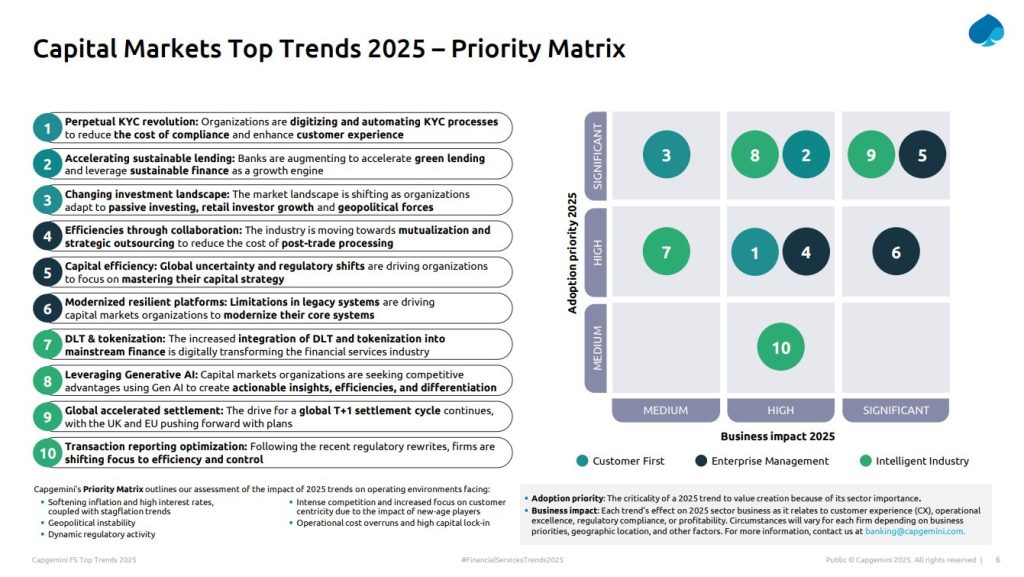
Capital Markets Technology Trends | Source: Capgemini
The Vision: Proactive AI Agents
Agentic AI is at the very top of Gartner’s hype cycle, which means the concept of autonomous agents is both highly invested in and significantly speculated about.
“ What I'm really interested in is sort of these AI agents. Why does a human have to go and upload the document into a chatbot and command to abstract it? Our AI extraction agent should be looking at everybody's email and if one of our analysts gets an operating statement or a rent roll, they don't need to ask to have it abstracted. It automatically does it. I think we're not there yet, but that's a world that we're headed towards. ”
Jason Berry, COO of Slatt Capital
This vision aligns with IOSCO’s findings that recent advancements in AI have led to “agentic” systems—AI systems that are “endowed with planning capabilities, long-term memory and, typically, access to external tools such as the ability to execute computer code, use the internet, or perform market trades” (source).
What is this podcast about?
The Concrete Voice is a commercial real estate technology podcast started by Arthur Ambartsumyan after over 10 years of honing his expertise in CRE, PropTech, FinTech, AI, and other technologies. He asks thought-provoking questions, so you get insightful answers and practical tips. The main goal is to make our listeners more informed about CRE technology innovations, trends, and future possibilities.
Can I become a guest?
We choose our guests very carefully to ensure the quality of insights but we are always open to collaboration. Please, contact us via email [email protected] to discuss the opportunity for your appearance in the next episodes.
Kateryna Mamchych
Kateryna is an experienced writer focused on topics related to Salesforce consulting and optimizing operations within the real estate industry via CRM implementation. Through her insightful articles, Kateryna aims to help organizations make the most of their Salesforce adoption.



 Loading...