Still Tracking Commissions in Spreadsheets or Disconnected Tools?
See how AscendixRE helps commercial real estate brokerages manage deals, splits, deductions, and payouts in one connected CRM.


Commercial real estate commission tracking should not be harder than the deals themselves. In many brokerages, it is.
A broker’s split changes. A co-broker deduction comes off the top. A payment arrives in stages. What should be a simple payout question turns into a manual hunt across spreadsheets, emails, and deal records.
That is why CRE commission tracking is not just about doing the math. It is about managing the workflow around it.
This guide compares five platforms commercial real estate brokerages are likely to evaluate and frames the real decision: do you want commission tracking inside your CRM, or in a separate back-office system?
Somewhere in a brokerage right now, someone is maintaining a spreadsheet with a tab for every broker on the roster – entering deals by hand, updating split balances, and tracing payout questions across emails and formulas. It works – until it doesn’t. A formula breaks. A broker gets promoted mid-year and the old split logic lingers in the wrong place. A payment arrives in two installments and someone has to reconstruct what is still owed.
That is the real problem with broken commission tracking. It does not just create admin work. It creates:
And in commercial real estate, the logic is rarely simple. A single lease may involve a lease-term commission schedule, a co-broker deduction off the top, referral or E&O deductions, a house split tied to a year-to-date production plan, and a payout that happens in stages.
That is why the real buying decision is not just “which software can calculate commissions?”
It is: do you want commission tracking inside the same system where your brokerage already manages deals, contacts, and reporting – or bolted on as a separate back-office layer?
To build this comparison, we reviewed product documentation, pricing pages, third-party reviews on Capterra, G2, and Software Advice, and Reddit. We also looked at how each platform handles the scenarios that cause problems in day-to-day brokerage operations.
We excluded residential-only platforms like SkySlope, Lone Wolf Back Office, and Dotloop from a detailed review. They’re good at what they do. They just don’t do commercial real estate commission tracking.
| AscendixRE | CommercialEdge | Buildout | Dealius | BoldTrail | Realcore | |
|---|---|---|---|---|---|---|
| Full CRM included | ✓ Integrated, Salesforce-based | ✗ Standalone back-office | Separate product ( $129/user/mo) | ✗ Standalone but pairs with RealNex | Separate product | ✓ CRE pipeline & CRM included |
| Commission module cost | ✓ Included with CRM | Separate module with custom quote | Separate add-on $85/broker/month | Separate product with custom quote | Bundled with opaque pricing | Part of the platform, custom quote required |
| Tiered commission plans | ✓ Fully configurable: unlimited tiers, date ranges, multiple plans per broker | ✓ Yes | ✓ Available (vendor-defined options) | ✓ Yes | ✗ Standard plans only | ✓ Yes |
| Co-broker fee handling | ✓ Native with pre-split deduction | ✓ Yes | ✓ Yes | ✓ Yes | ✗ Not natively | ✓ Yes |
| Platform extensibility | ✓ Add fields, formulas, flows, integrations (Salesforce ecosystem) | ✓ Vendor controls changes (Yardi ecosystem) | Proprietary (vendor controls changes) | Proprietary (vendor controls changes) | ✗ Inside Real Estate ecosystem | Proprietary (vendor controls changes) |
| Enterprise security (SOC 2) | ✓ Yes (inherited from Salesforce) | ✓ Yes (Yardi Cloud) | ✓ Yes (inherited from Salesforce) | ✗ Not disclosed | ✗ Not publicly confirmed | ✗ Not publicly disclosed |
| Accounting integration | MRI, QuickBooks, Sage (consulting-driven) | ✓ Yardi native | Limited | QuickBooks | QuickBooks | Built-in accounting + QuickBooks |
| CRE deal structure support | ✓ Full | ✓ Full | Standard structures only | ✓ Full | ✗ Residential-first | ✓ Full |
| Total cost model | $99/ user/month: AscendixRE + Salesforce license with commissions included | CommercialEdge suite with custom quote required | Rethink $129/user/mo + M&C $85/user/month add-on | CRM (separate) + Dealius license | Bundled with BoldTrail (pricing unclear) | Custom quote required |
AscendixRE stands out in this market because it treats commission tracking as part of the brokerage’s core operating system, not as a separate back-office product.
Instead of asking teams to manage deals in one system and commissions in another, AscendixRE brings commission tracking into the same CRM where brokerages already manage contacts, properties, deals, pipelines, and reporting.
That architectural choice matters in practice. It reduces double entry, keeps commission logic tied to the deal record, and gives firms one system of record from prospecting through payout. This is the clearest case AscendixRE makes in the market: commission tracking is included inside the CRM rather than sold as a separate layer alongside it.
Because the platform is built on Salesforce, brokerages also gain more flexibility as commission structures evolve. Firms are not limited to a rigid back-office tool. They can adapt workflows, reporting, and calculations inside a broader platform environment as the business changes.
That feature set already covers the mechanics of commission tracking. The AscendixRE AI Suite, a four-module AI layer built on top of AscendixRE (xRE Connector, Agent, Harvest, and Composer AI), extends it so brokers can ask instead of digging.
From a total cost perspective, AscendixRE is also one of the clearer options in the category. At $99 per user per month for the Enterprise tier, the platform includes a bundled Salesforce license, AscendixSearch, Composer, and commission tracking in the same system.
AI is available as an add-on. The AscendixRE AI Suite is open to Enterprise plan users and starts at $39 per month, depending on org size. That makes it easier for brokerages to budget around one operating platform instead of layering a separate commission product on top of CRM licensing.
The trade-off is that AscendixRE is not the lightest-weight option in this comparison. For brokerages coming from spreadsheets or simpler back-office tools, moving commission tracking into a broader CRE CRM can feel like a bigger decision than adding a standalone product.
But that is also the point. For firms that have already outgrown fragmented workflows, the goal is not to add another calculator. It is to stop managing commissions outside the system where deals already live.
Because of that, implementation support matters. Ascendix Technologies works with brokerages on configuration and data migration so the transition is planned and structured rather than disruptive. For firms making a broader operational upgrade, that support is part of the value, not an afterthought.
AscendixRE is a strong fit for mid-size to enterprise CRE brokerages that want one system from prospecting through payout and are ready to replace fragmented commission workflows with a more connected operating model.
See how AscendixRE helps commercial real estate brokerages manage deals, splits, deductions, and payouts in one connected CRM.
CommercialEdge Commissions is the most feature-saturated commercial real estate commission software available if you’re measuring purely by calculation depth. The question is whether you need that depth, and whether the Yardi ecosystem is where you already live.
CommercialEdge Commissions is the most feature-complete commercial real estate commission tracking software with strong accounting functionality and a complex split calculator, which is a genuine differentiator for larger brokerages with specific accounting requirements.
The platform has processed over $2 billion in commercial real estate deals and sits on Yardi’s enterprise security infrastructure with annual SOC 2 and biannual SOC 1 reports, CSA STAR Level 2 certification renewed January 2026.
The trade-off is that CommercialEdge Commissions is a standalone back-office system. Your CRM lives somewhere else, which results in double-entry for deal data and two systems to maintain. Pricing isn’t published and requires a direct enterprise quote. The Yardi ecosystem is powerful if you’re already in it. And if you are not, the integration path might be resource-consuming and require third-party service provider engagement.
CommercialEdge is the right choice if you’re managing 500+ annual transactions with complex accounting requirements, and Yardi is already your infrastructure backbone. If you’re evaluating commercial real estate commission tracking software from scratch and don’t have Yardi dependencies, the standalone architecture is a meaningful limitation.
Buildout’s pitch is compelling: one vendor for CRE prospecting, listing marketing, CRM, and commission tracking. It is the largest installed base in the CRE-native commercial real estate commission software category with over 40,000 CRE brokers across 2,000+ brokerages use some part of the Buildout stack. Here we focus on one of Buildout’s modules Manage & Close.
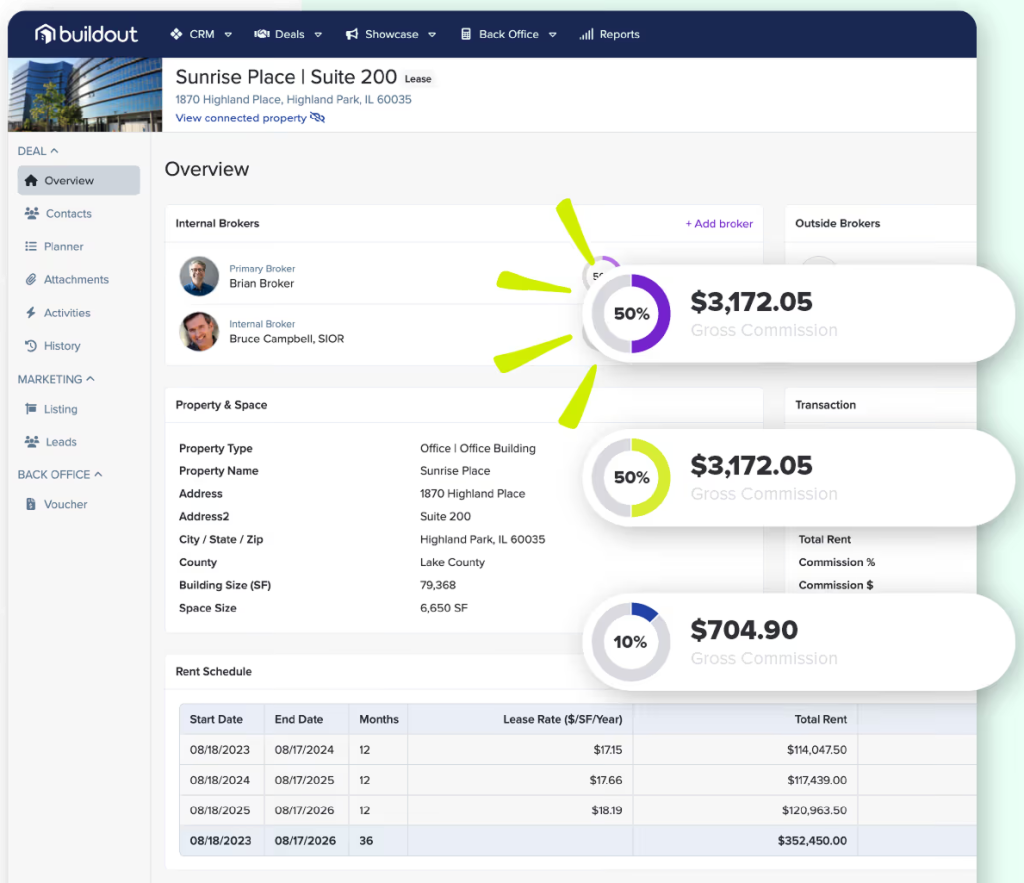
Buildout Manage & Close | Source: Buildout
Pricing reality. Rethink CRM at $129/user/month plus Manage & Close at $85/user/month equals $214/user/month minimum. And do not forget about set up and platform fees. For a 30-person brokerage, that’s nearly $80,000 per year before add-ons.
Rethink CRM and Manage & Close were built at different times by different companies and continue to operate as distinct applications resulting in the unified platform experience being less seamless than the vision suggests.
Commission logic customization beyond vendor-supported configurations requires a feature request that might be outsources to Buildout’s third-party service providers. It’s important to understand that Buildout’s roots are in real estate marketing functionality, and the rest is either acquisitions or add-on, including Manage & Close that acts as real estate commissions tracking software.
Buildout makes sense for brokerages where marketing and listing presentation quality drives revenue, and a single vendor relationship is worth the premium. It does not make sense if you’re primarily optimizing for commercial real estate commission tracking depth or total cost of ownership.
Dealius is the most purpose-built commercial real estate commission tracking software in this comparison and the highest-risk vendor to commit to.
The main risk is that Dealius is a small operation. Operations directors evaluating commercial real estate commission software for a multi-office brokerage should factor in vendor longevity. Pricing is not public. There are no reviews on G2, Capterra, or TrustRadius. No SOC 2 documentation is available.
The real competitive advantage is Dealius Capital offering commission advances on commercial leasing transactions. There is nothing like that on the market, but still with little information and marketing materials publicly available.
If you’re on RealNex and need a dedicated commission engine, Dealius is the strongest option. If you’re evaluating commercial real estate commission software without existing RealNex infrastructure, the ecosystem limitation and vendor scale are harder to overlook.
BoldTrail Back Office has more third-party social proof than any other platform in this comparison with approximately 800 reviews across Capterra and G2. While many praise its prefilling MLS addresses feature and effortless DocuSign integration, many complain about unprofessional customer support team calling onboarding a headache. Also, BoldTrail Back Office has one of the oldest and clunkiest interfaces on this list.
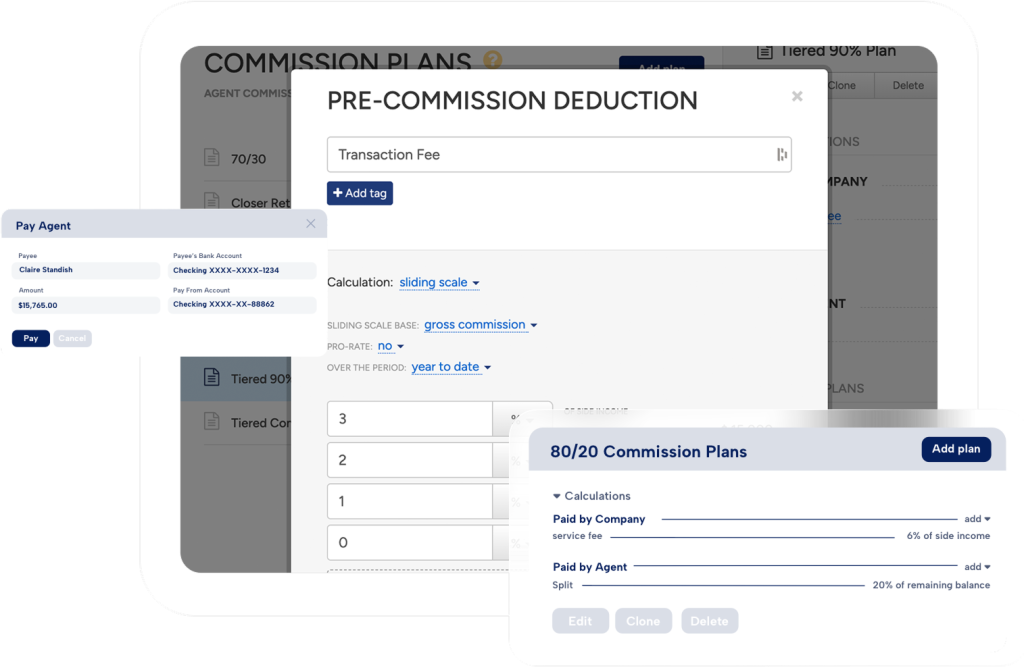
Source: BoldTrail
BoldTrail is positioned and built as a residential real estate solution. It has no native support for commission dollars per square foot calculations, lease-term percentage schedules, or CRE co-broker fee structures. As a real-life example, a commercial real estate commission calculator with broker split logic that works for a 5% residential sales commission will approximate simple CRE sales transactions, but it will hit hard limits on a 10-year industrial lease calculated at $0.35/SF per month.
It might be genuinely useful for hybrid residential/commercial brokerages where residential volume dominates. For pure-play CRE brokerages managing office, industrial, or retail leasing, BoldTrail is the wrong tool. The residential architecture outdated and buggy interface, opaque pricing, and unprofessional customer support can be deal-breakers.
Realcore is a CRE back office built by brokers to track their own agents’ production. Its edge is cash-flow visibility. Deals move from pipeline to commission review, billing, and payments in one workflow. Brokers see what lands in March, and when their split changes, without asking accounting.
What Realcore handles well:
Realcore tracks each installment against the transaction, so paid and outstanding amounts stay visible. Take a lease commission paid half at signing and half at occupancy. Before closing, the deal sits in the pipeline with its projected commission and payment dates. After commission review, the first payment posts against the transaction. The second stays visible as outstanding in the broker’s Payout Report and in firm receivables. Nobody has to reconstruct what is still owed.
Yes. A lease coming up for renewal goes back into the Realcore pipeline. The renewal commission then shows up in the forecast before anyone signs. Worth Commercial Real Estate, in a testimonial published by Realcore, says the platform replaced its manual spreadsheet checks on commissions and renewal dates.
Realcore also offers Next Level Support, an outsourced operations service. It covers transaction processing, invoicing, payment posting, and renewals. A brokerage without a back-office team can get the software and the people from one vendor. The company is also rolling out Angelo, an AI layer for querying transactions and earnings. Public detail on Angelo is still limited.
Realcore’s public documentation does not confirm either method. We could not verify lease-term percentage schedules or commission dollars per square foot calculations. Firms with complex leasing deals should test both in a demo with their own data.
Realcore covers the back-office workflow for RealNex firms that want commissions and cash flow in one CRE-specific system. It does not offer an extensible CRM platform or publicly documented enterprise security. For a growing brokerage, that weighs on the decision as much as the commission engine.
Three questions cut through the feature comparisons faster than any checklist.
If you want one system of record, your choice is between AscendixRE Enterprise (Salesforce-native CRM and commission module as a single subscription) and Buildout’s Rethink + Manage & Close stack (two products with separate subscriptions and platform fee from one vendor).
If you have an existing CRM you’re committed to and need a dedicated commercial real estate commission tracking engine to run alongside it, CommercialEdge Commissions (strongest in the Yardi ecosystem) or Dealius (strongest for RealNex users) are the right standalone options.
Simple sales commission splits across a small team? BrokerSumo or BoldTrail get you there at low cost. Graduated lease-term percentages, commission dollars per square foot industrial deals, multi-party co-broker arrangements with dynamic YTD tier recalculation across 20+ brokers? You need a CRE-native platform — AscendixRE, CommercialEdge, or Dealius.
This is where several platforms look very different on paper versus in practice.
Buildout is the most straightforward example of headline pricing that obscures real cost. Rethink CRM is $129/user/month. Manage & Close (the commission module) is priced separately on top of that for additional $85 per broker per month.
CommercialEdge and BoldTrail Back Office both require you to get into a sales conversation before you see a real number.
AscendixRE Enterprise is the only platform in this comparison where the published price is the real price. $99/user/month covers the CRM, the full commission module, and the Salesforce license. At 25 users that’s roughly $2,475/month which less than half what Buildout charges for the same headcount, and the only number you need to budget around unless you need specific customization.
Integration starts making sense around the 10-broker mark, or whenever a firm starts running multiple deal types at the same time. Below that threshold, a full platform can feel like overkill. Above it, maintaining two separate systems gets expensive in time, errors, and the ongoing effort of keeping them in sync.
One system of record. When the deal record and the commission record are the same record, a lot of friction disappears. A broker closes a deal, the commission calculation runs from the existing data, and payment is posted in the same place where the contact, property, and lease information already live. Nothing gets exported, re-entered, or reconciled.
Real-time revenue visibility. A standalone commission tool tells you what you owe on deals that have already closed. A commission module inside the CRM can see the live pipeline and forecast gross commission income.
Audit trail integrity. Every change to a commission calculation sits alongside the deal record. When a broker questions a split, you pull up one dashboard and show them the history without cross-referencing between platforms.
Broker transparency. When brokers can check their own YTD production, current split tier, and projected commissions from open deals in a single view, the “where does my commission stand?” conversation largely stops happening. That’s good for operations and, frankly, good for retention too.
The integration case is especially strong for firms migrating off legacy platforms. Bringing historical commission records like deals, splits, payment history into a platform you actually own and control is worth thinking about carefully.
Contact Ascendix Technologies and we eill help with safe data migration and change management.
Residential commission software handles MLS splits, franchise fees, and flat-percentage sales transactions. Commercial real estate commission tracking software handles lease-term splits, commission dollars per square foot calculations, co-broker fee structures, multi-tier production plans that recalculate dynamically throughout the year, and multi-installment payouts that can span months.
It can, but the tracking process will be time-consuming and complex. When the number of deals increases, tracking CRE commissions in a spreadsheet may turn into administrative work where even one mistake can have an impact. In this case, it is better to use CRE commission-tracking software with a predefined set of features to cover all needs.
A residential real estate commission calculator with broker split functionality won’t cover most of these.
Yes, with the AI add-on for AscendixRE CRM – AscendixRE AI Suite. It connects ChatGPT and Claude directly to your live AscendixRE data, so you can ask things like “What’s my year-to-date GCI?” or “Show me deals with commission payouts due this month” and get an answer without opening a report.
Kateryna is an experienced writer focused on topics related to Salesforce consulting and optimizing operations within the real estate industry via CRM implementation. Through her insightful articles, Kateryna aims to help organizations make the most of their Salesforce adoption.
 (73 votes, average: 5.00 out of 5)
 Loading...
AscendixRE is a great CRM for brokers of all sizes. Try AscendixRE CRM right now. We'll help you to set up everything and upload your data for free. No obligations.